Why Does Rust Spread Beneath Paint?
A tiny chip in paint can lead to bubbling and flaking far from the original damage. The cause is an electrochemical cell that forms under the coating and pushes the paint off from below.
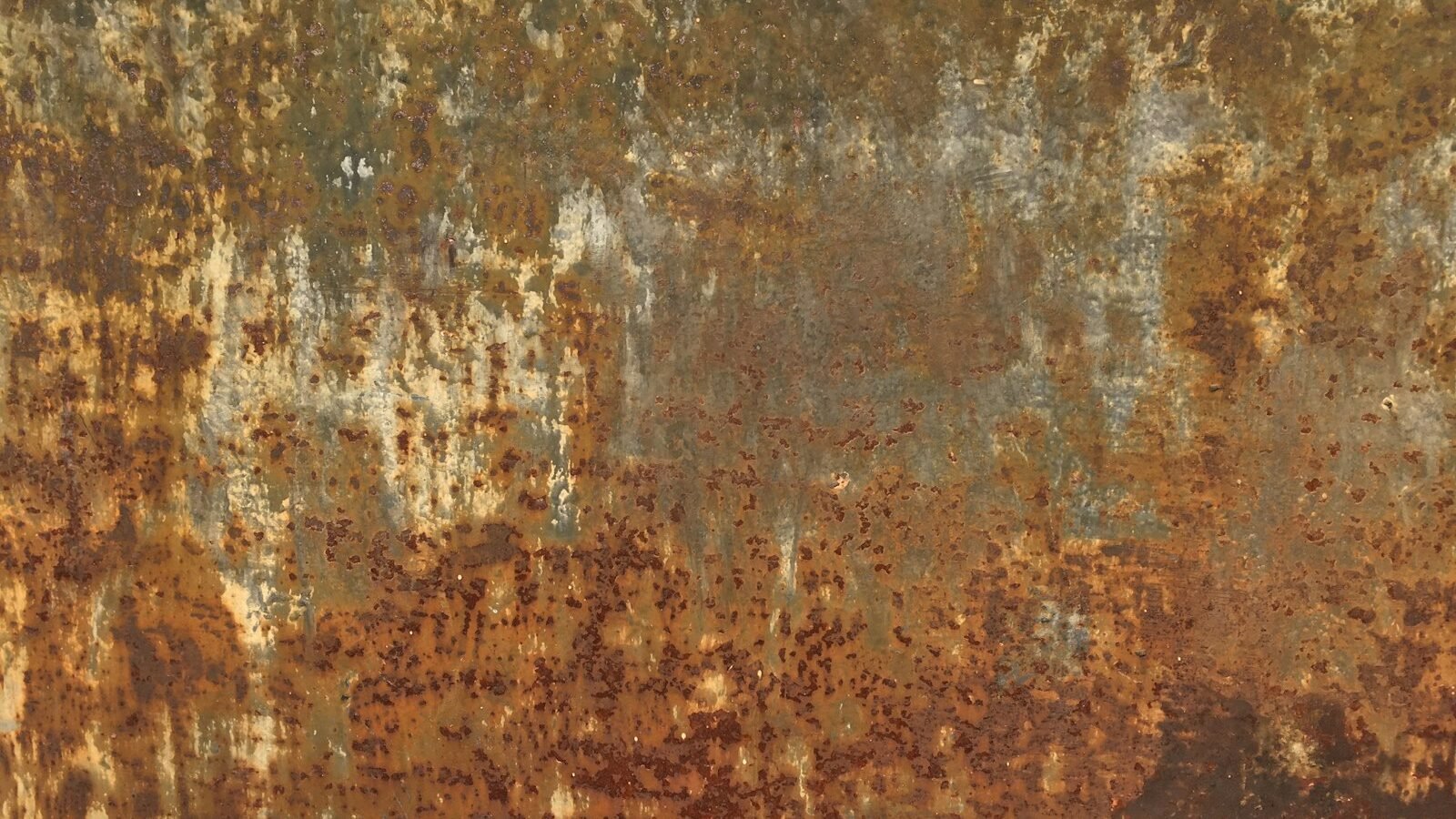
A car door picks up a small stone chip. Months later, the paint around it starts to bubble, and when you press the bubble, it crumbles to reveal orange rust spreading well beyond the original damage. The same thing happens on painted gates, railings and steel window frames. The paint looked intact; why did the rust travel underneath it?
The answer is that the chip is not just a hole where rust can start. It becomes one half of an electrochemical cell, and the other half forms under the paint, where its chemistry attacks the bond between coating and steel.
The short answer
- Rusting is electrochemical: metal dissolves at one place (the anode) while oxygen is consumed at another (the cathode).
- At a paint defect, steel dissolves and rust forms. Just under the edge of the paint, oxygen that has diffused through the coating is reduced, producing hydroxide.
- The strongly alkaline conditions at that hidden cathode break the paint’s adhesion, so the coating lifts and the corroding zone creeps outward. On steel this process is called cathodic delamination.
- Salt speeds it up, because dissolved ions carry the current between the two zones.
The basic principle: corrosion needs two reactions
Iron does not rust in a single step. Corrosion in water is an electrochemical process with two linked halves:
- Anodic reaction: iron atoms give up electrons and dissolve as iron ions. This is where metal is actually lost.
- Cathodic reaction: those electrons are used to reduce oxygen dissolved in water, producing hydroxide ions.
Electrons travel through the metal from anode to cathode, and ions move through the water to complete the circuit. The two halves do not have to happen at the same spot. They can be separated by millimetres or centimetres, as long as there is metal connecting them and moisture carrying ions between them.
Paint protects steel mainly by being a barrier: it slows the arrival of water, oxygen and salts at the metal surface and keeps any ions that do arrive from moving freely. A chip breaks that barrier at one point. What happens next depends on what the separated anode and cathode do.
How it spreads, step by step
- A defect exposes bare steel. A scratch, chip or pinhole lets water and salt reach the metal directly.
- The defect becomes the anode. Steel dissolves at the exposed spot and rust begins to form there.
- A cathode forms under the paint. Just beyond the edge of the defect, the paint is still attached, but oxygen and some water slowly diffuse through it. Electrons from the dissolving steel flow through the metal to this region, where oxygen is reduced to hydroxide.
- The interface turns alkaline. The hydroxide raises the pH sharply at the boundary between paint and metal.
- The paint loses its grip. High alkalinity attacks the chemical bonds holding the coating to the steel. The paint lifts from the metal, creating a thin gap that fills with electrolyte.
- The front moves outward. Positive ions such as sodium migrate from the defect along this gap to balance the charge. The cathodic zone moves further under the intact paint, and the anodic, rusting zone follows behind it.
- Bubbles and flakes appear. Corrosion products occupy far more volume than the steel they came from, pushing the loosened paint up into blisters that eventually crack.
The science behind it
Cathodic delamination
Corrosion scientists distinguish several ways corrosion can spread beneath organic coatings. On steel, including galvanised steel in wet conditions, cathodic delamination (also called cathodic disbondment) is typically the fastest mechanism. Laboratory studies using instruments such as the scanning Kelvin probe can map the electrical potential under intact paint and watch the delamination front advance.
Research on coatings applied directly to iron has found that the rate is often limited by how fast ions can migrate along the paint-metal interface from the defect. That is one reason why salt, which supplies mobile ions, makes underfilm corrosion so much worse.
Rust creepage and surface preparation
In coatings engineering, the distance corrosion travels from a scribe or defect is often measured as rust creepage or undercutting. Studies of steel surface preparation have found that surface topography matters: in one study, rust creepage was strongly inversely correlated with the density of peaks in the blasted steel profile. A surface with more, finer anchor points for the coating resisted creepage better.
Filiform corrosion
A different underfilm form produces thin, worm-like threads that wander beneath the paint. This is filiform corrosion. Each filament has an active head where the metal dissolves and a tail filled with corrosion products. It is especially common on coated aluminium and magnesium, but it can also occur on painted steel in humid, mildly salty conditions. On aluminium window frames, filiform corrosion is a familiar cause of thread-like blemishes under powder coating.
Real-world applications
- Cars. Stone chips on bonnets, sills and wheel arches, combined with road salt in some climates, are the classic case. Prompt touch-up limits the exposed area before delamination gets going.
- Structural steel. Bridges and industrial structures use multi-layer coating systems and careful surface preparation to slow underfilm spread from inevitable damage.
- Coastal property. Salt-laden air deposits chlorides on painted metal, accelerating any corrosion that starts at defects.
- Coating testing. Manufacturers deliberately scribe coated panels and expose them to salt spray or cyclic humidity, then measure how far corrosion creeps from the scribe.
Common misconceptions
“Rust under paint means the paint was too thin”
Thickness helps, but adhesion and surface preparation often matter more. Even a thick coating will delaminate if the surface beneath it was contaminated with salts, oil or existing rust.
“Painting over rust stops it”
Paint applied over rust usually fails early. Rust is porous, holds moisture and salts, and gives the new coating a weak base. Effective repairs remove corrosion back to sound metal.
“The rust started where the bubble is”
The bubble is often some distance from the original defect. The visible blister marks how far the delamination front has travelled, not where the problem began.
Limitations and exceptions
- Galvanised steel behaves differently. A zinc layer corrodes preferentially and can protect small areas of exposed steel, although coatings on galvanised steel can still delaminate in wet conditions.
- Dry environments slow everything. Without moisture to carry ions, the electrochemical cell cannot operate. Painted steel indoors in dry air can survive minor damage for decades.
- Inhibitive primers change the chemistry. Some primers release corrosion inhibitors at a defect, slowing the reactions that drive delamination.
- Mechanisms overlap. In practice, filiform corrosion and cathodic delamination can be hard to tell apart under pigmented paint, and both may occur on the same structure.
Frequently asked questions
How do I stop rust spreading under paint?
Remove loose paint and corrosion until you reach firmly bonded coating and clean metal, treat or prime the bare steel, and repaint with a compatible system. Doing this early, while the damaged area is small, makes the biggest difference.
Why does salt make it so much worse?
Dissolved salt supplies ions that carry current between the anode at the defect and the cathode under the paint, and chloride also disrupts protective films on the metal. Both effects speed up corrosion.
Do rust converters work?
Products that chemically convert rust can help on lightly rusted surfaces, but they do not restore adhesion under paint that has already lifted. Loose coating and heavy rust still need to be removed.
Why do aluminium window frames get thread-like marks?
That pattern is typical of filiform corrosion, which travels in filaments under coatings on aluminium, especially in humid coastal conditions.
References
- Mysliu, E., Taji, I. and Erbe, A. (2025). A review of filiform corrosion and its prevention on polymer-coated aluminium alloys. RSC Applied Interfaces, 2, 304–319.
- McMurray, H. and Williams, G. (2010). Under Film/Coating Corrosion. In Shreir’s Corrosion, Elsevier, pp. 988–1004.
- AMPP. Effect of Steel Surface Profile Peak Density on Rust Creepage, conference paper abstract.
- Swansea University. E-thesis on cathodic disbondment and filiform corrosion of a polyurethane coating applied directly to iron (2021).
Header photo: takis politis on Unsplash.