Why Do Potholes Form After Winter?
Potholes need cracks, water and traffic. Here is how water weakens the layers under a road, why freezing water widens cracks, and why patched holes return.
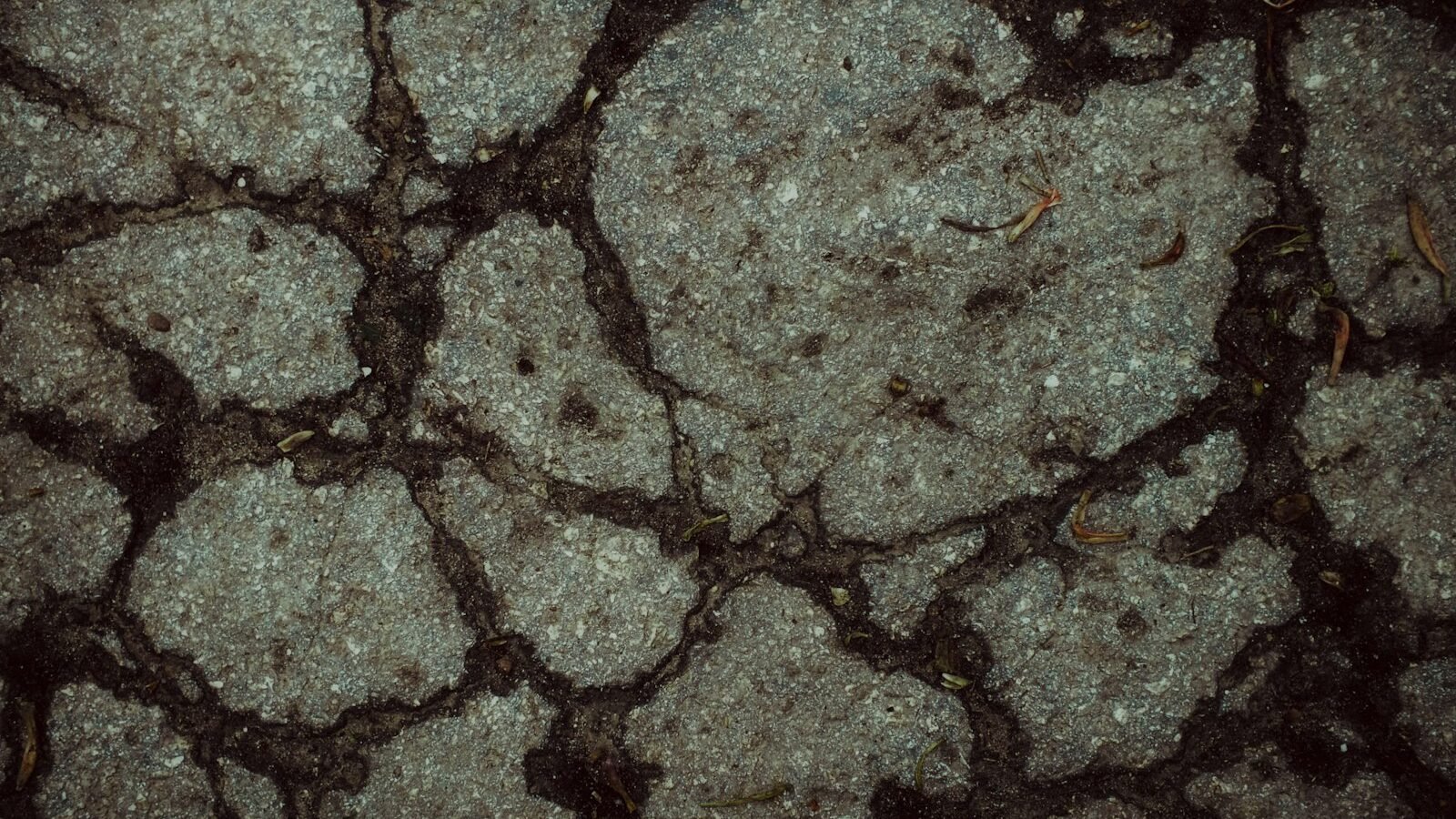
A road can look fine in autumn and be pitted with holes by early spring. Councils and road agencies brace for “pothole season” every year, and drivers notice it in their tyres, wheels and suspension.
Potholes are not random. They are the end point of a predictable chain: a crack lets water in, the water weakens what lies beneath, and traffic does the rest. Cold weather speeds the process up because water does something unusual when it freezes. Understanding the chain also explains why many patched potholes come back.
The short answer
- Potholes need three things: cracks in the surface, water, and traffic.
- Water entering through cracks softens and washes out the layers under the asphalt, leaving the surface unsupported.
- Water expands by roughly 9% when it freezes, so repeated freezing and thawing pries cracks wider and loosens the pavement.
- Wheels then break the weakened surface into pieces and throw them out, turning a crack into a hole that grows quickly.
The basic principle: a road is a layered structure
A typical road is not just a layer of asphalt. The black surface sits on layers of compacted crushed rock (the base and subbase), which rest on the natural soil, called the subgrade. The asphalt mainly provides a smooth, waterproof wearing surface. Much of the job of carrying heavy loads is done by the layers underneath, which spread each wheel load over a wider area of ground.
That system only works while the lower layers stay firm and dry. Once water gets in, the crushed rock and soil lose strength. The surface layer then has to bend under every passing wheel, a bit like a thin board laid over soft mud. Repeated bending causes more cracks, which let in more water. A pothole is what happens when this feedback loop runs to completion.
How it works, step by step
- Cracking. Repeated flexing under traffic causes fatigue cracks, often in a pattern that looks like crocodile or alligator skin. Ageing asphalt, poor drainage, temperature changes and badly backfilled trenches from utility work can all start or speed up cracking.
- Water entry. Rain and meltwater seep through the cracks and in from the road edges, saturating the base layers and softening the soil beneath.
- Pumping. Each heavy wheel squeezes the wet layers. Water is forced up and down, dragging fine soil particles into the gravel and weakening it further.
- Freeze-thaw (in cold climates). Water in the pavement freezes, expands and pushes the cracks wider. When it thaws, gaps are left behind, and more water fills them.
- Break-up. The unsupported surface breaks into loose blocks. Traffic knocks them out, creating a hole in the wheel path.
- Growth. Rainwater collects in the hole. Wheels splash it out and scour the edges, deepening and widening the pothole rapidly.
The science behind it
Why freezing water is so destructive
Most liquids shrink when they freeze. Water does the opposite. As it freezes, its molecules lock into an open crystal structure that takes up more space than the liquid. The density of ice is about 90% of the density of liquid water, which corresponds to an increase in volume of roughly 9%.
| State of 1 kg of water | Approximate volume |
|---|---|
| Liquid, near 0 °C | about 1.00 litre |
| Ice, at 0 °C | about 1.09 litres |
Inside a crack, that extra volume has nowhere easy to go. The ice acts like a wedge, pushing the walls of the crack apart and breaking up the asphalt around it.
An approximate worked example
Imagine a crack 100 mm long, 5 mm wide and 30 mm deep, completely filled with water.
water volume = 100 mm × 5 mm × 30 mm = 15,000 mm³ = 15 cm³
ice volume ≈ 15 cm³ × 1.09 ≈ 16.4 cm³
The ice needs about 1.4 cm³ more space than the water did. That sounds tiny, but it has to come from somewhere: the crack walls are forced apart, or material is pushed out. After thawing, the crack is slightly bigger, so it holds more water next time. These figures are an illustration only; real cracks are irregular and are rarely completely full.
Why the cycle matters more than the cold
One hard freeze does limited damage. What hurts roads is repetition. Each freeze-thaw cycle opens the cracks a little further and lets more water in. Freezing also draws extra water into the base layers, and in late winter, cycles can cause frost heave that lifts and cracks the pavement. When the ice melts from the top down, water is trapped above the still-frozen layer below and cannot drain away, leaving the base saturated just as traffic continues to pound it. That is why potholes tend to multiply in late winter and spring.
Real-world applications
- Road design. Engineers size pavement thickness and stiffness for the expected traffic. A pavement too thin for its loads develops fatigue cracking, the usual starting point for potholes.
- Drainage. Good drainage keeps water out of the base and subgrade. Poor drainage is one of the main underlying causes of repeated potholes.
- Crack sealing. Sealing cracks early aims to stop water reaching the layers below before a pothole can start.
- Patching methods. Road agencies use cold-mix patches as quick temporary fixes, especially in early spring, and hot-mix patches for longer-lasting repairs. A proper repair cuts the damaged area square and cleans and dries it so the new material bonds.
- Other materials. Concrete paths and slabs crack for their own reasons, covered in our article on why concrete develops hairline cracks.
Common misconceptions
“Potholes are caused by the cold”
Cold alone is not the cause. Water and traffic are essential. Freeze-thaw cycles accelerate the damage, but potholes also form in warm places wherever cracked pavement lets water into weak layers under heavy traffic.
“Filling the hole fixes the problem”
A patch treats the surface. If the underlying cause is a pavement too thin for its traffic or poor drainage, the weakened layers remain, and the pothole often reappears, sometimes quickly. Quick cold-mix patches are designed as temporary measures.
“Potholes appear suddenly”
The hole may open suddenly, but the damage underneath usually builds over months or years as cracks grow and the base becomes saturated. The final collapse is the visible end of a long process.
Limitations and exceptions
- Climate varies. In places that rarely freeze, freeze-thaw plays little part, and potholes are driven mainly by water, traffic loads and pavement age.
- Utility trenches. Holes over poorly backfilled trenches can form through settlement, even away from the main wheel paths.
- Concrete roads. Concrete pavements fail differently. For example, road salt reaching steel reinforcement can cause corrosion and expansion that cracks the concrete.
- Ageing asphalt. Over time, the binder in asphalt oxidises and becomes stiffer and more brittle, so older surfaces crack more readily. A similar ageing process is behind rubber becoming hard and brittle.
- Safety. Do not try to repair a public road yourself. Report potholes to your local council or road authority. For driveways and private roads, ask a qualified paving contractor or civil engineer to assess drainage and the base, not just the surface.
Frequently asked questions
Why are potholes worse in spring?
Repeated freeze-thaw cycles over winter widen cracks and saturate the base. In late winter, melting from the top down traps water in the pavement, which is then weakest exactly when traffic is still heavy.
Why do potholes usually form in the wheel tracks?
That is where the pavement flexes most. Most potholes start as fatigue cracks caused by repeated wheel loads, so they appear in the wheel paths rather than in the centre of the lane.
Why do some repairs fail within weeks?
Temporary cold-mix patches are not designed to last long, and any patch placed in a wet, dirty hole may not bond. If the base below is still weak, the surrounding pavement keeps breaking up.
Can a pothole damage my car?
Yes. Hitting a deep pothole can damage tyres, wheels and suspension. Slowing down and keeping a safe distance helps, but avoid swerving suddenly into other lanes or traffic.
References
- Tensar. Potholes: Causes, Formation, and Prevention.
- Maryland Department of Transportation State Highway Administration. Potholes.
- U.S. Geological Survey. Water Density.
- Pennsylvania Department of Transportation. How potholes form.
Header photo: Denis Agati on Unsplash.