What Is SEO in 2026? A Practical Guide With Real Case Studies

Type almost any question into Google, Bing, or Yahoo today and you’ll notice something that wasn’t true five years ago: often, an AI-generated summary — powered by a retrieval-augmented generation (RAG) architecture — appears above the traditional list of organic listings, answering your query before you’ve even clicked anything. This single shift — the rise of AI Overviews — has done more to change how SEO is talked about than any algorithm update in the last decade. And yet, underneath the new SERP interface, the fundamentals of search engine optimization haven’t disappeared. They’ve been sharpened, and the last two years have produced some unusually clear, publicly documented case studies of exactly what happens when a site’s ranking strategy gets that sharpening wrong — and right.
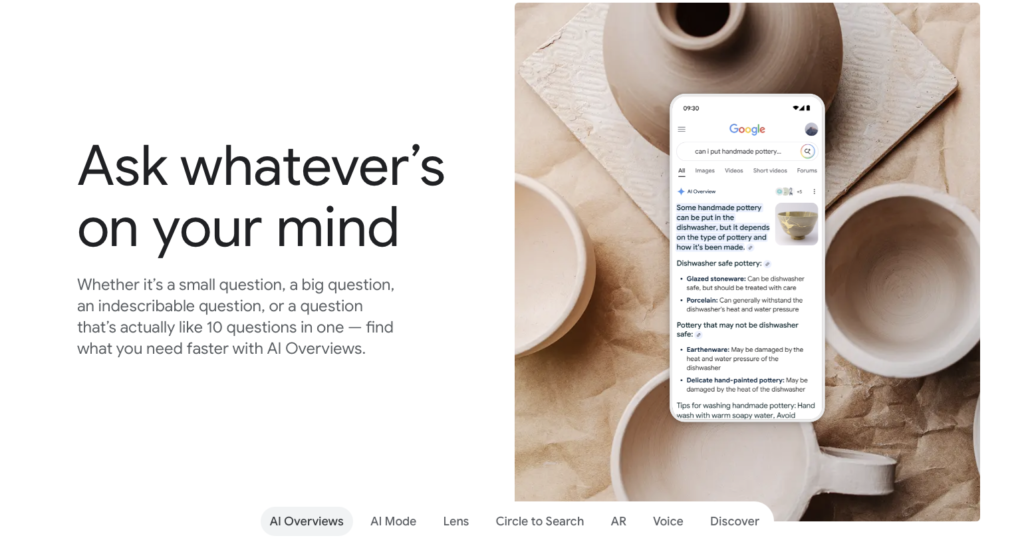
Source: search.google/ways-to-search/ai-overviews
This guide walks through what SEO actually is in 2026, why it still matters even in an AI-saturated search landscape, how the discipline has shifted since Google’s 2024–2026 wave of core algorithm updates, and — because frameworks are only useful once you’ve seen them break something real — three of the most closely analyzed case studies in recent SEO history.
What SEO Actually Means
Search engine optimization is the process of improving a website’s crawlability, indexability, and topical relevance so that search engines can discover it, parse its semantic structure, and confidently surface it to users querying related informational or transactional intent. That’s the definition in its simplest form — but “confidently recommend” is doing a lot of work in that sentence, and it’s worth unpacking rather than glossing over.
Google isn’t just running lexical keyword-matching against inverted indices anymore. Its ranking systems evaluate whether a page demonstrates real subject-matter expertise, whether it was plausibly authored by someone with genuine firsthand experience of the topic, whether it contributes information gain relative to the top-ranking corpus, and whether the domain as a whole carries a track record of demonstrated trust signals. SEO has moved from a largely mechanical discipline — matching search terms to page text — toward something closer to reputation management combined with technical execution. The case studies below exist precisely because that shift caught a lot of well-resourced, experienced marketing teams off guard.
A Simple Diagnostic: The Relevance-Depth Test
Before getting into specific companies, it’s worth introducing one analytical lens that makes the case studies easier to interpret, rather than treating each as an isolated anomaly. Call it the relevance-depth test: for any URL, ask two separate diagnostic questions — is this genuinely relevant to the site’s core topical authority, and does it exceed the information depth of the current top-ranking pages on the same query? A page can fail on either axis independently, and the failure mode manifests differently each time. Content that’s deep but topically off-vertical for the domain (a CRM company publishing an exhaustive guide to cover letters) dilutes the domain’s aggregate topical authority signal even if the writing quality is excellent. Content that’s on-topic but shallow gets outranked the moment a competitor publishes something with greater information gain. Keep this test in mind — every case study below fails one axis or the other, and correctly diagnosing which one determines what the remediation actually looks like.
Why SEO Still Matters When AI Overviews Exist
It’s a reasonable question: if an AI Overview answers the query directly on the SERP, why would a business still invest in organic search visibility? The answer is that AI Overviews aren’t synthesized from nothing — they’re generated via a retrieval layer pulling from pages Google has already crawled, indexed, and algorithmically judged relevant and credible, the same pages that would otherwise rank organically. Being cited inside an AI Overview is, in effect, a new and highly visible SERP feature position, and sites earning those citations have reported meaningful click-through rate (CTR) gains compared to a standard organic listing, because appearing as the source Google’s synthesis engine trusted enough to cite carries its own credibility (E-E-A-T) signal.
At the same time, a large share of purely informational queries now resolve as “zero-click” searches, because the AI Overview satisfies user intent entirely within the SERP. Publishing shallow, easily-summarized content aimed purely at broad head-term keywords is a weaker bet than it used to be. Content that goes further — original data, a distinct editorial point of view, something genuinely useful beyond the surface-level answer — is what continues to drive click-through, because it gives someone a reason to read past the synthesized summary.
The Three Pillars of SEO
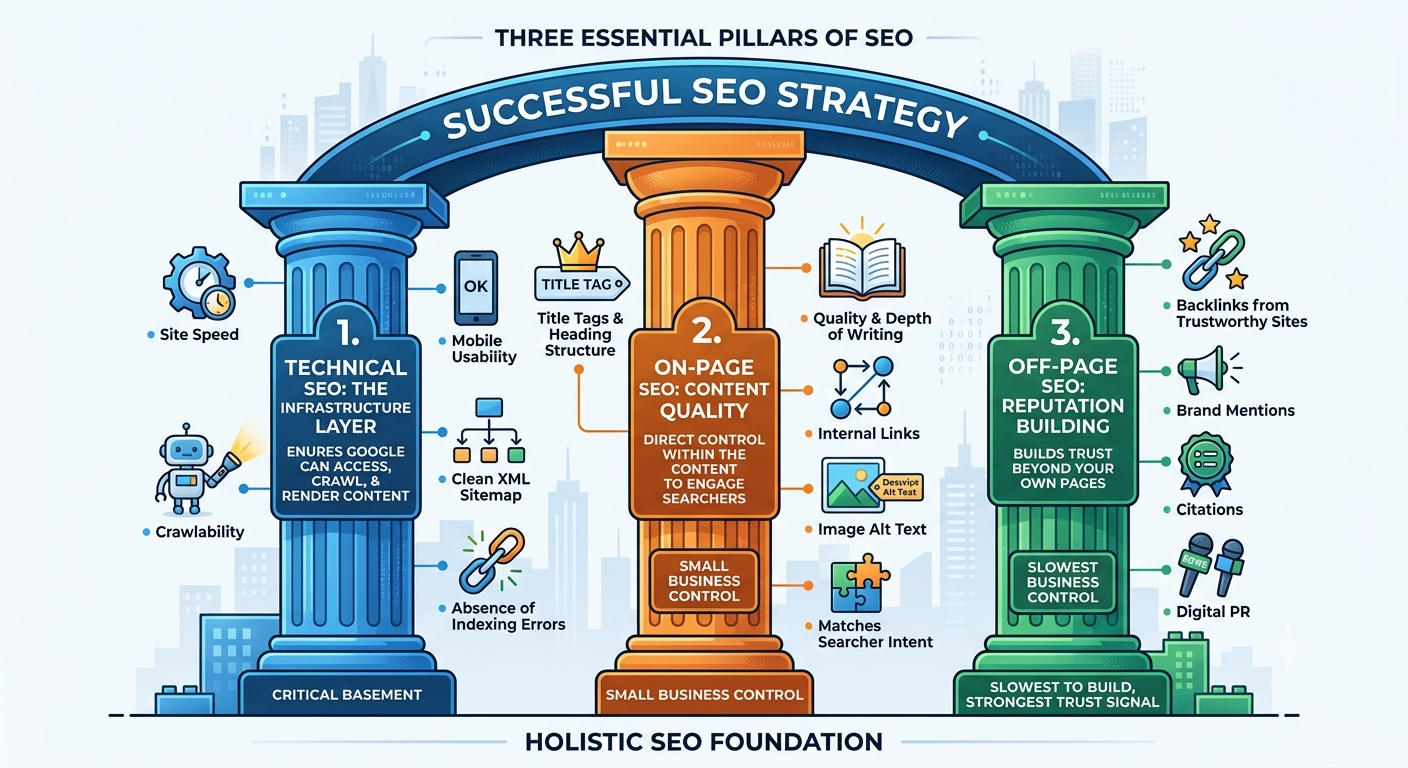
1. Technical SEO
Technical SEO is the infrastructure layer — it determines whether Googlebot can access, render, and properly index your content in the first place. This includes Core Web Vitals, mobile-first indexing readiness, crawlability, a clean XML sitemap, and the absence of indexing errors. No matter how strong the writing is, a URL that’s blocked from indexing, suffers poor render performance, or fails mobile usability will never get a fair chance to rank.
2. On-Page SEO
On-page SEO covers what you control directly within the content layer: title tags, semantic heading hierarchy, the actual quality and depth of the writing, internal linking architecture, image alt attributes, and query-content relevance alignment. This is usually where small businesses have the most direct control, and it’s where the biggest quality gaps show up between content engineered to rank and content engineered to genuinely satisfy user intent.
3. Off-Page SEO
Off-page SEO is about the domain authority a site accrues beyond its own pages — backlinks from trustworthy, topically relevant domains, unlinked brand mentions, citations, and digital PR. It’s the slowest pillar to build, since it depends on external editorial discretion, but it’s also one of the strongest trust signals within Google’s ranking algorithm.
Case Study 1: How HubSpot Lost the Majority of Its Blog Traffic
HubSpot is one of the more instructive case studies in recent SEO history precisely because it wasn’t a small, inexperienced domain — it was, for years, held up as a model of content-led SEO. Between early 2023 and early 2025, HubSpot’s blog subdomain saw its estimated organic traffic fall from roughly 24 million monthly visits to somewhere in the range of 6 to 8 million, according to third-party SERP-visibility tools like Semrush and Sistrix, with the steepest single drop occurring after the November and December 2024 core and spam updates. Separate tracking reported the number of keywords HubSpot ranked in the top three positions for falling from around 138,000 to roughly 30,000 over the same period.
What makes this a genuinely instructive case, rather than just an alarming headline, is the root-cause analysis. Analysts who audited the affected URLs found a consistent pattern: much of the lost traffic came from content with little topical relevance to HubSpot’s actual product vertical — pieces on topics like cover letter examples or generic sales quotes, which had driven meaningful traffic for years but did nothing to reinforce HubSpot’s topical authority in CRM and inbound marketing. Competing publishers with narrower, more topically focused coverage — sometimes with substantially longer, higher-information-gain guides on the same subjects — held or gained ranking position through the same updates. This is the relevance-depth test playing out at enterprise scale: the content wasn’t necessarily low-quality by traditional on-page standards, but it was topically off-vertical for what Google’s entity-resolution systems had come to understand HubSpot’s domain was actually authoritative about.
Notably, HubSpot’s business results didn’t collapse alongside its blog traffic — the company continued reporting revenue growth through the same period, a reminder that organic traffic and business health, while correlated, aren’t the same metric. But for any domain relying on blog content as a primary top-of-funnel acquisition channel, the lesson holds: topical breadth without topical alignment is increasingly fragile under Google’s current ranking model.
Case Study 2: Forbes Advisor and “Site Reputation Abuse”
Around the same period, Forbes experienced an estimated 60–80% decline in organic search visibility, concentrated heavily in Forbes Advisor, its affiliate content division covering topics like credit cards, insurance, and loans. The core issue Google’s spam-policy team identified was a practice it formally named site reputation abuse: publishing large volumes of third-party or loosely affiliated content on a subdomain or subdirectory of an otherwise reputable, high-domain-authority host, in an attempt to inherit that host’s established trust signals for topics the publishing team held no direct topical authority over.
Google’s enforcement response was a manual action specifically targeting this pattern, applied independent of the otherwise strong domain-level authority Forbes.com carried in its backlink profile. The lesson for smaller sites considering a similar architecture — hosting third-party or loosely supervised content under a trusted brand’s domain to inherit its authority — is that this is now an explicitly enforced spam-policy violation, not a gray-area growth hack.
Case Study 3: Reddit’s Rise and What It Signals About “Experience”
Not every case study from this period is a cautionary tale. Reddit’s search visibility grew dramatically — one widely cited SERP-visibility index tracked over a 1,000% increase in Reddit’s organic search visibility between mid-2023 and early 2024, with the platform climbing from roughly the 68th highest-visibility domain in Google’s US results to among the top five. Reddit threads began ranking, and continue to rank, for a wide range of product comparison, recommendation, and “is this normal” style queries that previously surfaced polished, professionally produced content instead.
The most useful interpretation of this shift isn’t “forums beat blogs” — it’s what Reddit threads structurally contain that a lot of professionally produced content doesn’t: specific, first-person accounts (a raw experience signal) of actually using a product or navigating a situation, visible disagreement and debate rather than a single manufactured editorial consensus, and community validation signals (upvotes, reply depth) that function as a crude but real proxy for whether other people found the answer genuinely useful. This lines up directly with the “Experience” component of Google’s E-E-A-T framework, which for years existed mostly as guidance for human Quality Raters and has become considerably more visible in actual ranking outputs since. The practical takeaway for businesses isn’t to abandon expert-authored content — it’s to ensure that content actually contains the specific, lived, first-hand detail that makes Reddit threads rank, rather than reading as a generic, interchangeable overview of the topic.
What Changed Between 2024 and 2026
Google’s core updates over the past two years share a consistent underlying theme: rewarding original, experience-backed content and algorithmically penalizing synthetic, derivative content at scale.
- “Information gain” became a measurable ranking signal. Google’s updates specifically targeted pages that reorganized or paraphrased what the existing top 10 results already said without contributing incremental value — the exact pattern behind much of HubSpot’s affected content.
- E-E-A-T moved from guideline to enforced ranking outcome. Experience, Expertise, Authoritativeness, and Trust had been part of Google’s Search Quality Rater Guidelines for years, but recent updates made these signals far more consequential to actual ranking outputs, not just to theoretical evaluation — visible in both Reddit’s rise and Forbes Advisor’s fall.
- Site reputation abuse became a named, enforced spam policy, closing off a specific tactic — inheriting a trusted domain’s authority for loosely related third-party content — that had previously existed in a policy gray area.
- AI Overviews became a mainstream SERP feature on informational queries, changing both click behavior and the strategic value of ranking well for broad, easily-summarized topics.
For a business owner or content strategist, the practical takeaway is this: the legacy playbook of publishing keyword-targeted articles and accumulating backlinks hasn’t been abandoned, but the quality threshold has risen substantially, and the reward for genuine topical alignment and firsthand experience has risen with it.
How SEO Actually Works, Step by Step
- Crawling — Googlebot discovers URLs, usually by following hyperlinks from pages already in its index, or via a submitted XML sitemap.
- Indexing — Once crawled, Google’s indexing pipeline parses and renders the page, deciding whether to store it in the Google Index, the database of content eligible to appear in search results.
- Ranking — For every query, Google’s ranking algorithm evaluates relevant indexed URLs against hundreds of weighted signals and determines SERP position.
- AI synthesis — For queries that trigger an AI Overview, Google’s generative retrieval systems pull from the same indexed, ranked corpus to construct a synthesized answer, often with inline source citations.
A common mistake is treating these as one-time events. In reality, the pipeline runs continuously — URLs get re-crawled, re-evaluated, and re-ranked constantly as the web graph evolves, which is exactly why HubSpot’s decline unfolded gradually over roughly ten months rather than overnight.
A Practical Starting Framework, Informed by the Case Studies Above
Step 1 — Confirm the technical foundation is sound. Use Google Search Console to verify indexation status, mobile usability, and the absence of major crawl anomalies.
Step 2 — Run your own content inventory through the relevance-depth test. Before adding anything new, segment existing URLs into those topically off-vertical for your core authority (HubSpot’s cover-letter problem) versus those on-topic but thin relative to current top results. These require architecturally different remediations — pruning or 301-redirecting the former, deepening the latter with genuine information gain.
Step 3 — Produce content that contributes information gain beyond the top-ranking corpus. A real example from your own operations, a specific quantified result, or a level of specificity competitors haven’t addressed. Generic restatement of commodity knowledge is precisely what recent core updates have algorithmically targeted.
Step 4 — Deliberately encode the “experience” signal Reddit’s ranking gains exploit. Include specific, firsthand detail — what actually happened, what surprised you, what didn’t work — rather than a smoothed-over, generic overview. This is the same underlying E-E-A-T signal, applied to owned content instead of a forum thread.
Step 5 — Never host loosely supervised third-party content under your primary domain’s authority. The Forbes Advisor case made explicit what was previously a policy gray area; treat any affiliate or syndicated content vertical as carrying real spam-policy risk if it isn’t genuinely produced and reviewed with the same editorial rigor as your core content.
Step 6 — Be realistic about timelines. SEO is a compounding strategy. Meaningful, sustained results typically take three to six months of consistent effort, and the case studies above show that decline, like growth, tends to unfold gradually before any single update rollout makes it visible in aggregate metrics.
Common Misconceptions About SEO in 2026
“SEO is dead because of AI Overviews.” Not accurate — AI Overviews are built from the same underlying ranking and retrieval infrastructure, and being the cited source is now one of the most valuable SERP positions available.
“More content is always better.” HubSpot’s case is the clearest available counterexample: a large, well-produced content inventory can lose the majority of its organic traffic when too much of it sits outside the domain’s genuine area of topical authority.
“A trusted domain can absorb any content placed on it.” Forbes Advisor’s manual action demonstrates this is no longer true in practice, if it ever reliably was under Google’s current spam-policy enforcement.
“Keyword density is what matters most.” Modern ranking systems evaluate semantic relevance, latent query intent, and — increasingly — demonstrated firsthand experience, far more than literal keyword repetition.
Frequently Asked Questions
How long does SEO take to show results?
Most businesses start seeing measurable ranking movement within three to six months, with more substantial gains compounding over six to twelve months, depending on competitive density and consistency of execution.
Could a HubSpot-style traffic collapse happen to a smaller site?
Yes — the underlying mechanism (broad, topically off-vertical content diluting a domain’s perceived area of authority) applies at any scale. Smaller sites are arguably more exposed, since they carry less overall domain authority to absorb the dilution effect.
Is AI-written content bad for SEO?
The issue isn’t the production methodology used to draft content — it’s whether the final output demonstrates genuine expertise, originality, and specific, firsthand usefulness. Content generated at scale with minimal human editorial oversight or added value is what recent spam policies specifically target.
Final Thoughts
SEO in 2026 rewards fundamentally the same thing it always has: content that genuinely satisfies user intent, delivered on a technically sound domain, backed by real, verifiable credibility. What’s changed is the sophistication with which Google’s ranking algorithms can now distinguish real expertise from content engineered purely for ranking manipulation — and the past two years have produced unusually clear, public evidence of exactly what that looks like when it goes wrong, and when it goes right.
References
- Search Engine Land — HubSpot SEO traffic drop coverage
- Aleyda Solis — Analysis of HubSpot’s organic traffic decline
- Google Search Central — March 2024 core update and spam policy announcement
- Google Search Central — Site reputation abuse spam policy
- Orange SEO — Analysis of Reddit’s search visibility growth