GEO vs SEO: Do You Need a Different Strategy for ChatGPT and Gemini?
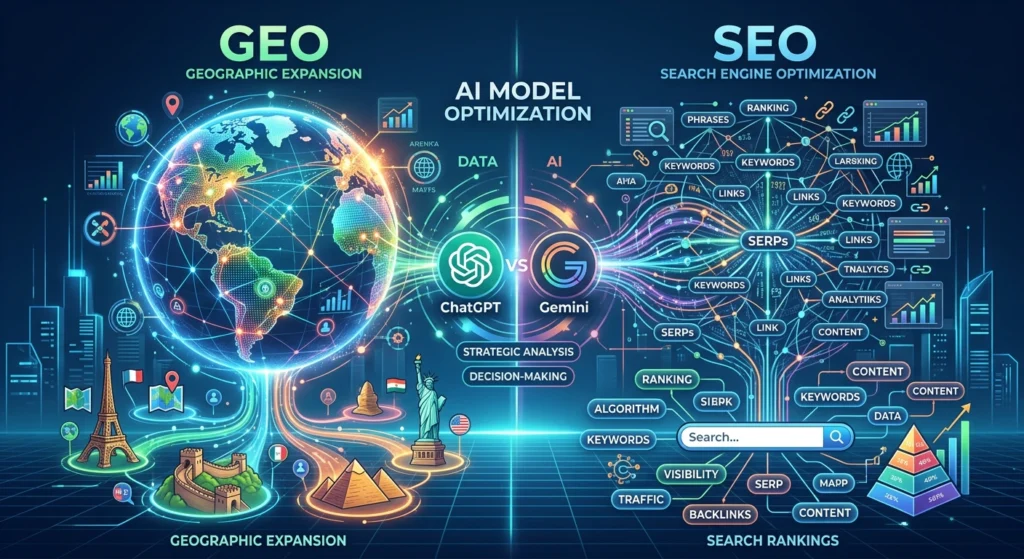
As conversational AI tools like ChatGPT, Gemini, and Perplexity have become mainstream ways people find information, a new term has entered marketing conversations: GEO, or Generative Engine Optimization — the practice of optimizing content specifically for retrieval and citation by large language model (LLM)-based generative systems, as distinct from optimizing for traditional lexical and link-based search rankings. Given how much marketing attention (and how many paid “GEO audits”) this term has attracted, it’s worth examining honestly what GEO actually is, how it differs from traditional SEO at a mechanistic level, and where the two genuinely diverge versus where GEO is largely a rebranded application of existing information retrieval (IR) principles.
What GEO Claims to Be
Generative Engine Optimization is generally described as the practice of optimizing website content so that it’s more likely to be retrieved, ranked, and synthesized by generative AI platforms during answer construction — a process most of these systems implement via retrieval-augmented generation (RAG), in which a retrieval layer surfaces candidate passages from an index or live crawl, and a generative model then synthesizes those passages into a natural-language response. This includes Google’s own AI Overviews, but the term is most often used in the specific context of standalone conversational AI tools and chatbots that aren’t necessarily built on Google’s search index at all.
How Different AI Platforms Actually Source Their Information
This is the most important architectural distinction to understand, because it directly affects whether a single unified optimization strategy is even technically coherent:
Google’s AI Overviews are built directly on top of Google’s own search index — the same crawling, indexing, and ranking infrastructure used for traditional organic results, augmented by generative synthesis models (reportedly built on Gemini-family architectures) operating over that same retrieved corpus. A page needs to already satisfy standard technical and on-page SEO criteria to have any realistic chance of entering the retrieval candidate set here.
ChatGPT (when using browsing or search features) draws on a combination of its pretraining corpus (parametric knowledge encoded in model weights) and, for browsing-enabled queries, live web search results via a retrieval layer, which in various implementations have relied on search infrastructure from providers including Microsoft Bing.
Perplexity operates as a dedicated answer engine built around real-time retrieval and citation — architecturally closer to a pure RAG pipeline than a hybrid parametric/retrieval system — with a strong emphasis on providing direct, inline source attribution.
Gemini, as Google’s own foundation model, has deep integration with Google’s search index and Knowledge Graph, similarly to AI Overviews.
The practical implication is that there isn’t a single, unified “GEO index” to optimize for in the way there’s a single Google index to optimize for with traditional SEO. Different platforms draw on different combinations of parametric (training-data-encoded) knowledge, non-parametric live retrieval, and third-party search partnerships — meaning genuinely platform-specific technical tactics are less reliable and less durable than a strategy built around the underlying fundamentals shared across all of them.
What Genuinely Overlaps Between GEO and SEO
The substantial majority of what’s marketed as “GEO strategy” is, on close examination, standard SEO best practice applied with additional intentionality:
- Crawlability and machine-accessibility is a shared prerequisite — a technically broken, JavaScript-render-blocked, or robots-disallowed site can’t enter the retrieval candidate pool of any system, generative or traditional
- Genuine content originality and information gain matters for both — synthetic, derivative content is unlikely to be selected as a citation source by a retrieval-ranking mechanism for the same reason it struggles in traditional lexical/semantic rankings: it doesn’t add anything a model couldn’t already infer from its parametric knowledge or other retrieved sources
- Clear semantic structure and directly extractable answers assist both human scanning behavior and the passage-extraction step generative systems perform when parsing a document for retrieval
- Established authority and trust signals — backlink graph position, brand entity recognition, demonstrated E-E-A-T (Experience, Expertise, Authoritativeness, Trust) — appear to function as a credibility prior influencing which sources generative ranking layers treat as citation-worthy, much as they influence traditional PageRank-adjacent authority signals
Where Genuine Differences Exist
Citation format and attribution vary by platform architecture. Some platforms display explicit inline citations (a retrieval-transparent design); others synthesize information without direct source attribution at all, meaning the visibility benefit of being a “source” varies considerably depending on the platform’s citation methodology.
Some platforms rely more heavily on static parametric knowledge than live retrieval. This means very recent content may take longer to influence certain generative systems’ outputs — bound by the model’s training data cutoff and retraining cadence — compared to how quickly it can enter a live, continuously-updated search index via standard crawling. This is a meaningful consideration for time-sensitive content.
Brand entity recognition may carry disproportionate weight in generative synthesis. Because generative models are, in part, drawing on latent representations learned from vast training corpora reflecting aggregate internet consensus and brand reputation, established, widely-recognized brand entities may hold an inherent prior advantage in generative contexts beyond what page-level optimization alone can influence.
Unverified and Overhyped GEO Tactics
The rapid growth of interest in GEO has produced a market for tactics with limited or no empirically verified evidence behind them, including:
- llms.txt files — a proposed protocol/standard for signaling content specifically to AI crawlers and retrieval agents, which despite some adoption, has not been confirmed as something major AI platforms or Google actually parse or weight in any meaningfully impactful way
- Artificial content “chunking” — restructuring content into unusually small semantic segments specifically to appeal to hypothesized AI passage-parsing behavior, which Google’s own 2026 guidance explicitly addressed, clarifying this isn’t necessary
- Keyword stuffing with AI-related terminology — attempting to signal relevance to generative systems by inserting phrases like “AI-friendly” or similar terms directly into content, with no verified benefit to retrieval ranking or citation likelihood
Given the lack of confirmed evidence, time and resources are generally better allocated to the fundamentals that reliably influence both traditional lexical/semantic ranking and generative retrieval, rather than speculative platform-specific hacks.
A Practical, Unified Strategy
Rather than treating GEO as an entirely separate discipline requiring its own dedicated strategy, a more defensible approach treats it as an extension of strong foundational SEO, with a few additional considerations layered on top:
- Maintain excellent technical SEO so content is reliably crawlable and indexable by any retrieval system, traditional or generative.
- Prioritize genuinely original, expert content with measurable information gain over derivative summarization, since this is what distinguishes citation-worthy sources across virtually every retrieval architecture.
- Structure content with clear, direct, extractable answers (well-segmented passages, explicit definitions, semantic heading hierarchy), benefiting both Answer Engine Optimization (AEO) within Google’s ecosystem and passage-level citation likelihood on dedicated answer engines like Perplexity.
- Build genuine off-page authority and brand entity recognition, since this appears to function as a credibility prior across generative systems, not just within traditional link-graph-based Google rankings.
- Avoid chasing unverified, platform-specific technical hacks in favor of investments that reliably compound across both traditional and generative retrieval contexts.
Frequently Asked Questions
Do I need a separate content strategy for ChatGPT versus Google?
Not fundamentally. The underlying qualities that make content valuable to a retrieval and synthesis pipeline — genuine expertise, originality, semantic clarity, and demonstrated trustworthiness — are consistently rewarded across platforms, even though the specific mechanics of citation and visibility vary by architecture.
Is it worth paying for a dedicated “GEO audit” service?
Given how much overlap exists between GEO and standard SEO/IR fundamentals, it’s worth carefully evaluating what a GEO-specific audit actually offers beyond a standard technical SEO and content quality audit before investing separately in it.
Will GEO become more distinct from SEO over time as AI platforms mature?
It’s possible platform-specific retrieval and citation mechanics will become clearer and more actionable as these systems continue to develop, but the core principle — genuine quality and originality outperforming synthetic, derivative content within any retrieval-ranking system — is likely to remain the consistent foundation regardless of how the specific architecture evolves.
Final Thoughts
GEO is a genuinely useful lens for thinking about how content gets retrieved and cited within generative AI pipelines, but it’s not the wholesale departure from SEO fundamentals that some marketing around the term suggests. The platforms differ meaningfully in their underlying retrieval architecture — parametric versus non-parametric knowledge, RAG versus hybrid synthesis, explicit versus implicit citation — which makes a single, unified strategy grounded in genuine content quality, technical soundness, and demonstrated authority a more reliable long-term investment than chasing speculative, platform-specific tactics with limited verified evidence behind them.
For the practical, platform-agnostic side of this, see our guides to Answer Engine Optimization and structuring content for AI citation.