How to Recover From a Google Core Update Traffic Drop
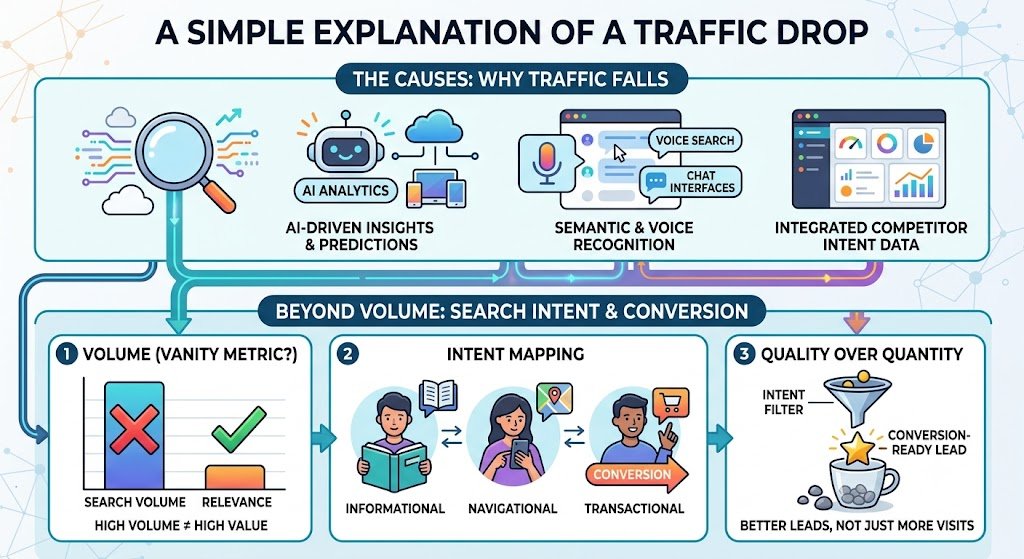
Watching organic traffic drop after a Google core update is one of the more stressful experiences a business owner or content creator can have — it’s sudden, it’s often unexplained in any specific diagnostic detail from Google, and the instinct is usually to make rapid, sweeping changes in the hope of reversing it quickly. That instinct, however, is often exactly the wrong response. Recovering from a core update drop requires a methodical, evidence-based root-cause analysis — and, frankly, patience.
First: Confirm It’s Actually a Core Update Issue
Before attributing a traffic drop to a core update, rule out other common causes that are frequently mistaken for algorithmic impact:
- A technical regression, such as a broken XML sitemap, an accidental noindex directive introduced during a deploy, or a server outage during a critical crawl window
- A tracking or analytics misconfiguration, such as a broken GA4 property setup or a tracking script that failed to fire after a template change
- A seasonal or genuine demand-curve shift, where aggregate search volume (query volume) for your topic has simply declined regardless of your ranking position
- A manual action, which Google explicitly discloses to site owners via the Search Console Security & Manual Actions report, and which requires an entirely different remediation pathway (a reconsideration request) than an algorithmic core update
Checking Google Search Console’s Security & Manual Actions report, along with correlating the timing of the traffic drop against Google’s publicly documented Search Status Dashboard rollout dates, is the fastest way to confirm whether a core update is genuinely the relevant causal factor.
Step 1: Identify Exactly Which Pages and Queries Were Affected
Rather than analyzing aggregate site-wide traffic, use Google Search Console’s Performance report to run a comparative time-series analysis of the weeks immediately before and after the update rollout. Filter by page (URL-level) and by query to identify:
- Which specific URLs lost the most impression share and click volume
- Whether the drop is concentrated in specific topical verticals or distributed evenly across the site
- Whether average position degraded incrementally, or whether the URL was fully deindexed/dropped from the ranking set for those queries entirely
This granular, segmented view is far more diagnostically useful than an aggregate traffic number, because it isolates where to focus remediation effort rather than treating the entire site as uniformly affected.
Step 2: Study What’s Now Outranking You
For your most significantly affected URLs, query the target search term and objectively benchmark the pages now ranking above yours in a competitive SERP analysis:
- Are they more comprehensive, covering sub-intent questions your page doesn’t address?
- Do they demonstrate more direct, first-hand E-E-A-T signals — author bios, specific examples, verifiable credentials?
- Are they more current, referencing recent data or developments your page lacks (a freshness/recency signal)?
- Are they simply from a domain with stronger overall authority and trust signals (a higher domain-level authority score)?
This comparison is often uncomfortable, because it requires objectively assessing whether a competitor’s content genuinely outperforms yours on quality — but it’s the single most useful diagnostic step available, since Google’s core updates are fundamentally a relative re-ranking exercise, not an absolute quality score applied in isolation.
Step 3: Distinguish Between a Content Problem and a Site-Wide Trust Problem
Core update impacts generally fall into one of two categories, and they call for architecturally different remediation approaches.
A content-specific issue (URL-level or template-level) affects particular pages or topical clusters, while other parts of the site remain ranking-stable. This usually points to those specific URLs needing genuine content-depth improvement — more information gain, more original insight, more current data.
A site-wide trust or quality issue (domain-level) affects the site broadly, often following a spam-focused update or where Google’s classifiers have reassessed the domain’s aggregate quality signals. This is a harder problem to remediate quickly, because it typically requires demonstrating a sustained pattern of quality improvement across a statistically meaningful share of the site’s content inventory, not just a handful of URLs.
Step 4: Improve, Don’t Just Tweak
For URLs genuinely losing ground to more comprehensive competitors, the fix is rarely a superficial edit — updating a timestamp, adding a paragraph, or adjusting keyword density. Meaningful recovery generally requires:
- Adding genuinely original content — examples, proprietary data, or perspective the page currently lacks (see the related concept of “information gain”)
- Closing the gaps identified in Step 2’s competitive analysis — specific sub-intent questions or angles the now-outranking competitors cover that your page doesn’t
- Strengthening demonstrated E-E-A-T signals — clear author entity information, more specific and verifiable detail, references to real first-hand experience
- Removing or consolidating genuinely thin content elsewhere on the site, particularly if a site-wide (domain-level) quality issue is suspected, since low-quality URLs elsewhere can drag down the aggregate quality signal Google’s classifiers assign to the domain as a whole
Step 5: Be Realistic About Timelines
This is the hardest part of core update recovery: meaningful content improvements often don’t produce a visible ranking recovery immediately. Google’s crawling infrastructure needs to re-crawl and re-render the improved content, and in many cases, genuine recovery is only fully reflected once the next broad core update rolls out and re-evaluates the site relative to the improvements made — since core updates function as periodic, batch re-scoring events rather than a continuously re-evaluated live signal for every quality dimension. This can mean waiting weeks or, in some cases, months — a timeline that’s frustrating but consistent with how core updates are understood to operate architecturally.
What Not to Do After a Core Update Drop
Don’t panic-delete large volumes of content without careful root-cause analysis. While pruning genuinely thin or low-value URLs can help in cases of a confirmed site-wide quality issue, removing substantial, otherwise-reasonable content based on an unverified hypothesis can do more harm than good to the site’s overall content footprint.
Don’t chase surface-level technical tweaks as a primary remediation. If the underlying issue is content quality relative to competitors, technical adjustments like schema markup additions or meta description rewrites won’t meaningfully move the ranking needle on their own.
Don’t submit a reconsideration request. This process is specifically scoped to manual actions, not algorithmic core update impacts, and submitting one in response to a core update drop has no procedural effect.
Don’t make dramatic changes mid-rollout. Broad core updates can take one to two weeks (sometimes longer) to fully propagate across Google’s index, and rankings can fluctuate meaningfully during that window. Wait until the rollout has substantially completed, per Google’s Search Status Dashboard, before drawing firm causal conclusions about what actually happened.
Building Long-Term Resilience Rather Than Repeated Recovery Cycles
The businesses that experience the least disruption from each new core update are generally those that maintain consistently high content quality as an ongoing operational practice, rather than treating SEO as a one-time content push followed by years of neglect. Practical habits that build this resilience include:
- Periodically reviewing and refreshing older content on a defined audit cadence rather than leaving it static indefinitely
- Maintaining a genuine editorial standard that prioritizes original insight and information gain over raw publishing volume
- Monitoring Search Console regularly enough to catch gradual, incremental declines early, rather than only noticing after a dramatic, update-driven drop
- Building real topical depth and demonstrated E-E-A-T signals over time, rather than relying on technical optimization alone
Frequently Asked Questions
How long should I wait before making changes after a core update?
It’s generally best to wait until Google’s Search Status Dashboard confirms the update’s rollout is substantially complete, then spend time carefully diagnosing the drop before making changes — rather than reacting within the first few days of observed volatility.
Will my rankings automatically recover once I improve my content?
Not automatically or immediately. Improvements typically need to be re-crawled and re-evaluated by Google’s ranking model, and full recovery is often only reflected at the next broad core update, though some gradual improvement can occur sooner as smaller ongoing refinements process the change.
Is it possible that a core update drop is permanent?
It’s possible if the underlying quality gap relative to competitors isn’t meaningfully addressed. However, drops are not inherently permanent — many sites have recovered, and in some cases exceeded previous rankings, by genuinely remediating the specific quality gaps a core update surfaced.
Final Thoughts
Recovering from a core update traffic drop is rarely about finding a quick technical fix — it’s about honestly diagnosing whether your content still merits its previous ranking position relative to what’s now outperforming it, and being willing to make substantive, information-gain-driven improvements rather than surface-level tweaks. The businesses that treat each update as useful, if uncomfortable, diagnostic feedback about their content’s real quality tend to emerge from these cycles stronger than those looking for a shortcut back to their previous rankings.
To understand what recent updates actually changed, see our breakdown of Google’s 2026 core updates.