Keyword Research in 2026: Tools, Intent, and Why Volume Isn’t Everything
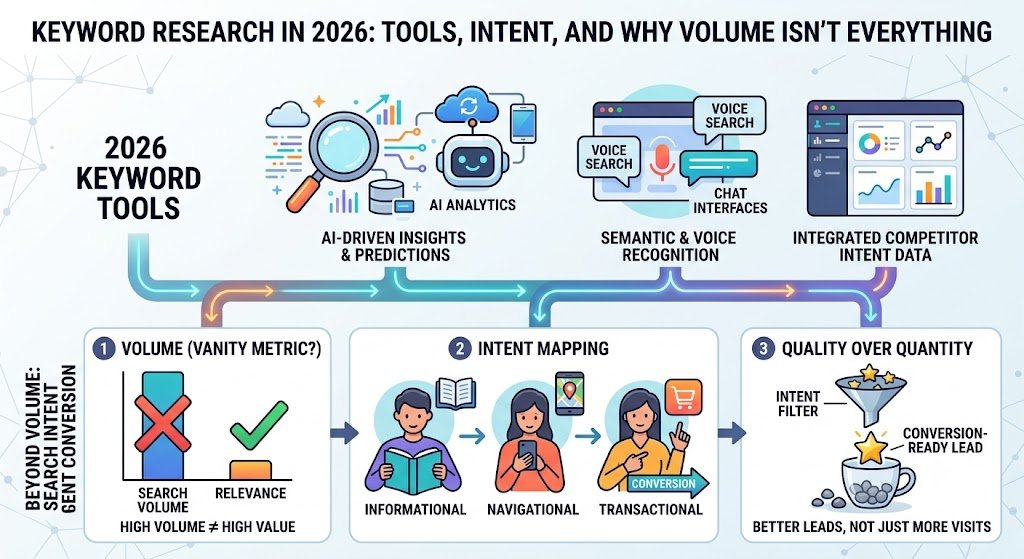
For most of SEO’s history, keyword research followed a simple formula: find the search term with the highest monthly volume, write a page targeting it, and wait for traffic. That formula has been breaking down for years, and in 2026 it’s arguably obsolete as a primary strategy. Between AI Overviews absorbing a growing share of informational clicks and Google’s core updates increasingly rewarding depth and originality over volume-chasing, keyword research today is less about hunting for big numbers and more about genuinely understanding what a searcher wants — and whether you’re the right source to give it to them.
This guide walks through a complete, practical approach to keyword research as it actually works in 2026.
Why Search Volume Alone Is a Misleading Metric
A keyword showing 10,000 monthly searches looks appealing on paper. But that number tells you almost nothing about:
- Whether the intent matches your business. A high-volume term might be searched primarily by people with no intention of ever buying anything related to your offer.
- Whether an AI Overview already satisfies most of that demand. If Google’s AI-generated summary fully answers the query at the top of the page, a large share of that search volume may never result in a click at all — recent industry data suggests AI Overviews can reduce organic clicks on top-ranking results by roughly a third for some query types.
- How competitive the term actually is, and whether ranking for it is realistic given your site’s current authority.
A keyword with only 150 monthly searches, but a near-perfect match to buyer intent and a clear reason for the searcher to click through rather than rely on a summary, can be dramatically more valuable to a business than a broad, high-volume term that mostly generates traffic with no commercial relevance.
The Four Types of Search Intent
Every keyword falls into one of four broad intent categories, and correctly identifying which one you’re targeting fundamentally changes how the page should be written.
1. Informational intent. The searcher wants to learn something — for example, “what is technical SEO” or “how does Google rank websites.” These queries are the most likely to be fully answered by an AI Overview, meaning content here needs to offer something beyond a surface-level definition to earn a click.
2. Navigational intent. The searcher is looking for a specific website, brand, or tool — for example, “Ahrefs login” or a specific company name. These queries are largely irrelevant to target unless it’s your own brand.
3. Commercial investigation intent. The searcher is comparing options before making a decision — for example, “best SEO tools for small business” or “SEO agency vs freelancer.” This is often a valuable zone for content, because it sits close to a purchasing decision without being fully transactional.
4. Transactional intent. The searcher is ready to act — for example, “hire SEO consultant Sydney” or “buy waterproof hiking boots online.” These queries typically have lower search volume but the highest direct commercial value.
Mismatching intent — writing a hard sales page targeting a purely informational query, or a generic blog post targeting a clearly transactional term — is one of the most common and avoidable reasons content underperforms.
A Complete, Practical Keyword Research Process
Step 1: Start with your own expertise, not a tool
Before opening any keyword tool, list the actual questions your customers or clients ask you directly — in emails, sales calls, or consultations. These real, first-hand questions are often better keyword seeds than anything a tool will suggest, because they reflect genuine intent and are the exact foundation for the kind of experience-based content Google’s E-E-A-T guidelines reward.
Step 2: Expand with keyword research tools
Once you have a seed list, tools help you understand scale and related variations:
- Google Search Console (free) shows the exact queries your site already appears for, including impressions and average position — often the fastest path to quick, low-effort wins, since you’re already partially visible for these terms.
- Google Keyword Planner (free) provides volume estimates and seasonal trend data, though it’s designed primarily for ad campaigns.
- Ahrefs and Semrush (paid) offer more detailed competitive analysis, keyword difficulty scoring, and gap analysis against competitor sites.
- “People Also Ask” and related-question data are useful for identifying the specific sub-questions a comprehensive page should address.
Step 3: Check the actual search results page, not just the tool data
Before committing to a keyword, search it yourself and observe:
- Does an AI Overview appear? If so, which sources is it citing, and what depth of content earned that citation?
- What content format currently dominates the top results — a listicle, a long-form guide, a comparison table, a product page?
- Are the top-ranking pages genuinely comprehensive, or is there an obvious gap you could fill with more original or specific content?
Step 4: Group keywords by topic, not by individual term
Rather than planning one thin page per keyword variation, group related terms into a single topic cluster. Modern SEO consistently rewards comprehensive coverage of a subject over a scattered collection of narrow, overlapping pages. A single, thorough guide covering a topic and its related sub-questions will typically outperform five separate shallow articles targeting keyword variations of the same idea.
Step 5: Prioritize by intent match and realistic value, not raw volume
For each keyword or cluster, ask three questions: Does this genuinely match what my business offers? Is the searcher likely to click through rather than rely entirely on an AI Overview? Is this a competition level realistic for my site’s current authority? Prioritize keywords that score well on all three, even if their volume is modest.
Keyword Research Specifically for AI Overviews
Because AI Overviews synthesize information from multiple sources rather than linking to just one, it’s worth treating this as a distinct check in your research process. For any priority keyword, look specifically at whether an AI Overview currently appears, and examine which sites it draws from. This tells you the depth, structure, and credibility bar you need to clear to realistically be considered a citation source — and it often reveals content gaps the AI-cited sources haven’t filled, which is exactly where original, differentiated content has the best chance of both ranking and earning a citation.
Common Keyword Research Mistakes
Chasing volume over intent match. A high-volume keyword with weak commercial relevance to your business wastes resources on traffic unlikely to convert.
Ignoring what you already rank for. Many businesses overlook Search Console data showing keywords they already have partial visibility for — often the fastest wins available, requiring only content improvements rather than starting from zero.
Treating every keyword variation as a separate page. This leads to thin, overlapping content that competes against itself and dilutes topical authority rather than building it.
Failing to check current SERP behavior. Keyword tools show historical volume, not what’s actually happening on the results page today — including whether an AI Overview has changed the click dynamics entirely for that specific query.
Skipping competitive reality checks. Targeting extremely competitive keywords without the site authority to realistically compete is a common way to invest significant content effort with little return.
Frequently Asked Questions
Is keyword research still worth doing if AI Overviews answer so many questions directly?
Yes — arguably more than ever, because understanding intent now determines not just whether you rank, but whether ranking actually results in a click. Keyword research should now explicitly include checking whether a query is likely to be fully satisfied by an AI Overview before committing resources to targeting it.
How many keywords should one piece of content target?
A single well-structured page can realistically target one primary keyword along with several closely related variations and sub-questions, provided they’re all part of the same genuine topic and intent. Trying to force unrelated keywords into a single page tends to dilute focus and hurt relevance.
Are free keyword tools good enough for a small business?
Google Search Console and Keyword Planner are genuinely sufficient for most small businesses, especially in the early stages. Paid tools become more valuable when you need detailed competitive gap analysis or are operating in a highly competitive niche.
Final Thoughts
Keyword research in 2026 isn’t about finding the single highest-volume term and building a page around it — that approach increasingly wastes effort chasing traffic that either won’t convert or won’t even click through past an AI Overview. The more durable strategy is mapping the real questions your customers ask, matching content format and depth to genuine search intent, and building topical clusters rather than scattered, disconnected pages.
Worried a page leans too hard on one phrase? Run it through our free Keyword Density Checker to spot over-optimisation before you publish.