On-Page vs Off-Page vs Technical SEO: What’s the Difference?
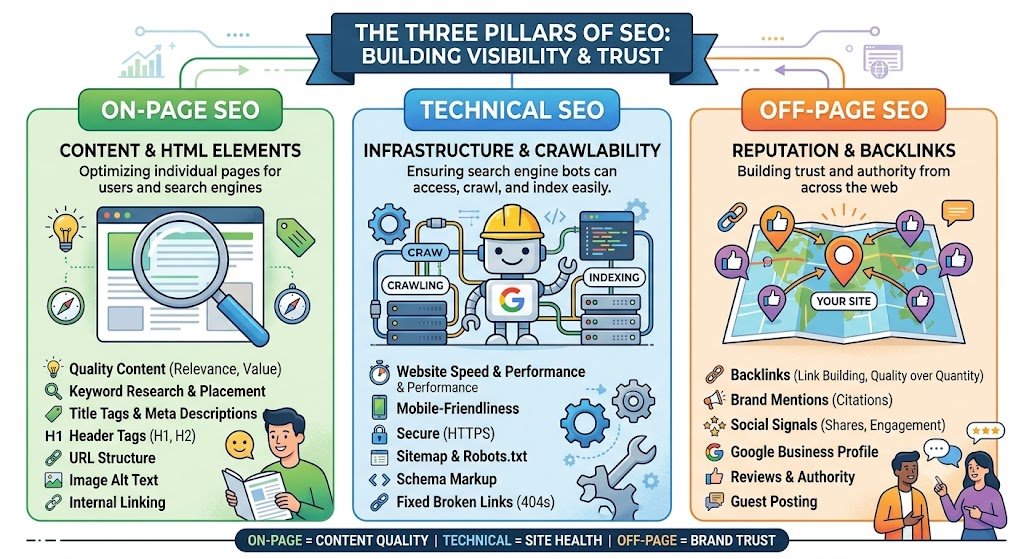
Ask five different marketers to explain SEO and you’ll likely get five different answers, because “SEO” is really an umbrella term covering three distinct disciplines, each with its own skill set, timeline, and failure modes. Confusing these categories is one of the most common reasons business owners misdiagnose why a website isn’t ranking — they’ll pour effort into content (on-page) when the real blocker is a broken sitemap (technical), or chase backlinks (off-page) when their actual URLs don’t yet merit ranking on content quality alone.
This article breaks down all three pillars in detail, explains how they interact structurally, and gives a practical framework for deciding where to allocate limited time and budget first.
On-Page SEO: What You Control Directly on the Page
On-page SEO refers to every optimization decision made within the content and markup of an individual URL. This is the area most business owners have the most direct, immediate control over — no third party needs to cooperate, and changes can often be deployed the same day.
Core on-page elements
Title tags. The clickable headline rendered in the SERP. An effective title tag is specific, includes the primary keyword naturally (not force-fit), and gives the searcher a clear reason to click over competing listings. Titles that are vague or overly clever at the expense of clarity tend to underperform on click-through rate (CTR).
Meta descriptions. While not a direct ranking factor within the core algorithm, a well-written meta description significantly affects CTR, which functions as an indirect relevance and engagement signal.
Heading structure (H1, H2, H3). A single, clear H1 states the page’s primary entity/topic; H2s decompose the content into logical semantic sections; H3s handle sub-points within those sections. Good semantic heading hierarchy isn’t just an SEO checkbox — it’s also what allows AI Overviews’ passage-extraction layer to accurately parse and summarize your key claims.
Content depth and quality. This is, by a wide margin, the most consequential on-page factor in 2026. Google’s recent core updates have specifically rewarded pages demonstrating real subject-matter expertise and algorithmically penalized pages that merely restate what competitors already say (a failure of information gain). Depth here doesn’t mean padding word count — it means genuinely resolving the sub-intent questions a reader would naturally have.
Keyword usage and semantic relevance. Rather than repeating an exact-match phrase, modern content should naturally achieve topical completeness — covering related terms, entities, questions, and concepts a subject-matter expert would be expected to address (a semantic-coverage approach favored by NLP-based ranking models).
Internal links. Links to other relevant URLs on your own domain distribute link equity (PageRank flow) and signal topical relationships within the site’s link graph.
Image optimization. Descriptive file names and alt attributes improve accessibility compliance and can drive incremental traffic through Google Images discovery.
URL structure. Short, descriptive, human-readable URL slugs consistently outperform long strings of dynamic parameters or opaque IDs, both for crawl efficiency and user trust.
A practical on-page checklist
- Does the title tag clearly describe the page and include the primary topic/entity naturally?
- Is there one clear H1, with a logical H2/H3 semantic hierarchy beneath it?
- Does the content resolve the query intent more thoroughly or with greater information gain than the current top-ranking pages?
- Are there at least 2-3 relevant internal links to other URLs within the site’s topical cluster?
- Do images carry descriptive alt attributes?
- Is the URL slug short and human-readable?
Off-Page SEO: What Happens Beyond Your Website
Off-page SEO is about the domain-level reputation and authority your site earns within the broader web link graph — signals that exist outside of pages you directly control.
Core off-page factors
Backlinks. A hyperlink from another domain to yours functions as a vote of confidence within Google’s link-graph authority model. Not all backlinks carry equal weight — a link from a well-established, topically relevant, high-trust domain carries far more authority signal than dozens of links from low-quality or topically unrelated sources. Quality has always mattered more than raw link count, and this gap has widened as Google’s SpamBrain-class detection systems have matured.
Brand mentions. Being referenced online, even without a clickable hyperlink, still contributes to how Google’s entity-resolution systems model your brand’s reputation and Knowledge Graph presence — sometimes referred to as an “unlinked mention” or implied link.
Digital PR. Earning coverage in industry publications, local news, or niche communities is one of the most effective (if labor-intensive) ways to build genuinely authoritative backlinks, because editorial gatekeepers are generally selective about which sources they cite.
Social signals. Social shares are not a confirmed direct ranking factor within the core algorithm, but the traffic and visibility they generate can indirectly produce natural backlinks and branded search queries, both of which do influence ranking outcomes.
Why off-page SEO is the hardest pillar to control
Unlike on-page or technical SEO, off-page authority depends on other people and organizations exercising independent editorial discretion to reference you. This makes it the slowest pillar to build, but also one of the hardest for competitors to replicate quickly, which is exactly why it carries so much weight within ranking algorithms — it functions as a much stronger anti-manipulation signal than page content alone.
Technical SEO: The Foundation Everything Else Sits On
Technical SEO ensures that search engines can actually crawl, render, and properly index your website’s infrastructure in the first place. It’s invisible to most visitors, but without it, none of your on-page or off-page investment matters.
Core technical factors
Site speed. Slow-loading pages degrade both user experience and ranking eligibility. Google’s Core Web Vitals — field metrics measuring loading performance (LCP), interactivity (INP), and visual stability (CLS) — are a direct, measurable ranking input sourced from real-user CrUX data.
Mobile-friendliness. Google evaluates the mobile-rendered DOM of your site as the primary version for indexing and ranking purposes (mobile-first indexing), meaning a poor mobile experience directly damages rankings even if your desktop rendering looks polished.
Crawlability. This includes a properly configured robots.txt file, a clean and current XML sitemap, and the absence of problematic redirect chains or orphaned URLs that Googlebot can’t efficiently reach within its allocated crawl budget.
Indexability. URLs must not be accidentally excluded by noindex directives or X-Robots-Tag headers, and duplicate or near-duplicate content needs to be properly consolidated (typically via canonical tags) so Google’s canonicalization algorithm isn’t left resolving ambiguity about which version to rank.
Site architecture. A logical information architecture that groups related content into topical clusters strengthens both crawl efficiency and topical authority signals.
Schema markup. Structured data doesn’t alter how content renders for human visitors, but it explicitly encodes for search engines (and increasingly, AI Overviews’ retrieval layer) exactly what entity type a page represents — a Product, an Article, a Recipe, a FAQPage — which can improve both traditional rich-result eligibility and AI citation likelihood.
A practical technical SEO checklist
- Is the site loading acceptably fast on mobile network connections, not just desktop broadband?
- Does the mobile rendering of every important URL display and function correctly?
- Are there crawl errors surfacing in Google Search Console’s Pages report?
- Is there a current, accurate XML sitemap submitted to Search Console?
- Are duplicate URLs properly canonicalized?
- Is relevant schema markup implemented where applicable (FAQPage, Article, LocalBusiness, Product)?
How the Three Pillars Interact
It helps to think of these three pillars as architectural layers of a single ranking system rather than separate competing priorities.
Technical SEO is the foundation layer. If Googlebot can’t crawl and index your site properly, exceptional content and strong backlinks are largely wasted expenditure — the URL simply won’t be evaluated fairly by the ranking algorithm, if at all.
On-page SEO is the substance layer. Once a URL is properly accessible, its actual content quality and information gain determine whether it merits ranking at all, and how well it competes against pages targeting the same query intent.
Off-page SEO is the credibility layer. Even excellent content on a technically sound domain can struggle to outrank established competitors in competitive verticals without external validation in the form of backlinks and brand-entity reputation.
A concrete illustration: imagine two domains publishing nearly identical, high-quality guides on the same topic. If one has a faster, cleaner technical implementation and a handful of relevant backlinks from industry-authoritative sources, it will typically outrank the other — not because its content is superior, but because the surrounding technical and off-page signals give Google’s ranking model more confidence in it.
Where Should You Focus First?
For most small businesses starting out or working with a constrained budget, this prioritization sequence tends to produce the fastest measurable results:
1. Remediate technical basics first. This is usually the fastest and cheapest layer to address, and it removes silent structural blockers that would otherwise cap the ROI on every subsequent investment.
2. Strengthen on-page content depth next. Audit your highest-priority URLs and honestly assess whether they resolve the searcher’s query intent with greater information gain than what’s currently ranking. This is where most of your ongoing time investment should be allocated.
3. Build off-page authority once the first two layers are solid. There’s limited ROI in aggressively pursuing backlinks to a URL that isn’t technically sound or well-written — you’d essentially be building reputation equity for content that doesn’t yet merit it.
Frequently Asked Questions
Which is more important: on-page or off-page SEO?
Neither functions well in isolation. On-page SEO determines whether your content merits ranking on quality grounds; off-page SEO determines whether Google’s trust model has sufficient confidence in your domain to rank it ahead of established competitors on merit alone.
Can I do technical SEO myself, or do I need a developer?
Many technical basics (submitting a sitemap, checking Core Web Vitals in Search Console, fixing broken links) are approachable for non-developers. More complex issues — like server-side configuration, structured data implementation at scale, or large-scale redirect-map management — often benefit from developer or specialist involvement.
How many backlinks do I need to rank?
There’s no fixed number within Google’s ranking model. What matters far more is the topical relevance and trustworthiness of the linking domains relative to your competitive set, not a raw backlink count.
Final Thoughts
None of these three pillars functions in isolation, and treating SEO as a single flat checklist rather than three interconnected architectural disciplines is one of the most common reasons SEO investment underperforms. A technically sound domain, filled with genuinely high-information-gain content, backed by real-world credibility signals, is the combination that consistently wins — within traditional ranking systems and within the AI-driven, retrieval-augmented search landscape increasingly built on top of them.
Checking your on-page basics is a good place to start — our free SEO Title & Meta Checker shows whether your titles and descriptions fit within Google’s display limits.