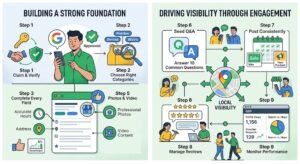
Local SEO Checklist for Small Businesses in 2026
For most small businesses, local search visibility matters more than broad national rankings ever will — a plumber, dentist, or local bakery doesn’t need to outrank the whole internet, just the handful of nearby competitors surfacing in the Local Pack when someone searches “near me.” The good news is that local SEO remains one of the more approachable areas of SEO for a small business to manage without a large budget, provided the ranking fundamentals are handled with discipline.
How Google Ranks Local Results
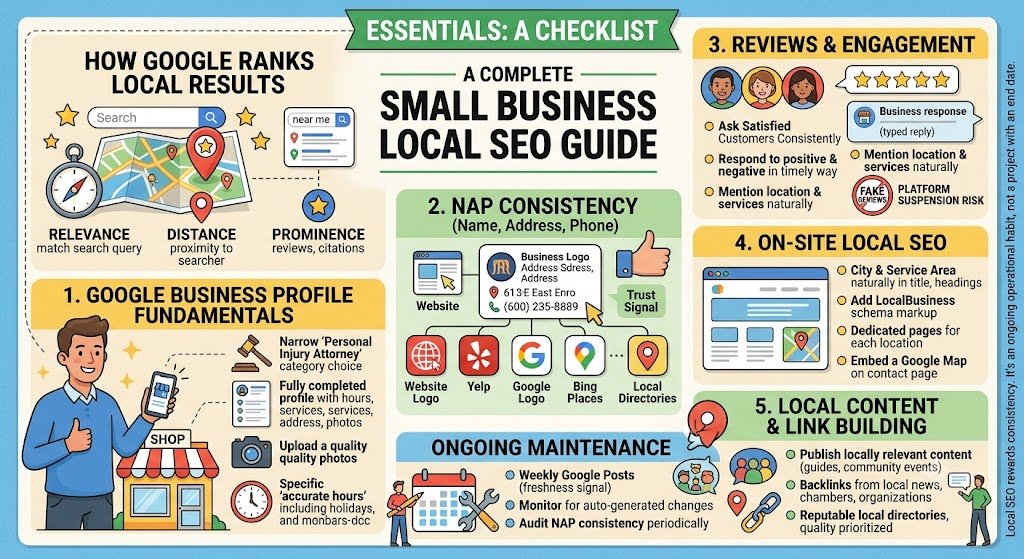
Google’s local ranking algorithm evaluates three core factors: relevance (how well your business entity matches the searcher’s query intent), distance (the geographic proximity of your business to the searcher or the searched location), and prominence (how well-known and well-regarded your business is, based on aggregate signals like review volume/quality, backlink authority, and citation consistency). Everything in this checklist ultimately reinforces one or more of these three ranking inputs.
Google Business Profile Fundamentals
- Choose the narrowest accurate primary category. Category selection is one of the single highest-impact taxonomy edits available — a more specific, accurate category (e.g., “Personal Injury Attorney” instead of the generic “Law Firm”) can meaningfully change local visibility for relevant query matches.
- Complete every section of the profile — business hours, service area radius, attributes, website link, and a detailed business description — since an incomplete entity profile sends a weaker trust signal to Google’s local ranking model than a fully populated one.
- Upload high-quality photos regularly, including storefront, interior, team, and product/service imagery, and keep the asset library current.
- Keep hours accurate, including special hours for holidays and temporary closures — inconsistencies between stated and actual hours generate negative user-engagement signals that Google’s systems can detect and factor into prominence scoring.
NAP Consistency Across the Web
Your business Name, Address, and Phone number (NAP) should be identical across your website, Google Business Profile, and other citation sources like Yelp, Bing Places, and industry-specific directory listings. Inconsistent NAP data — a different suite number here, an abbreviated street name there — can weaken the entity-resolution confidence and prominence signals Google’s local algorithm uses to evaluate your business.
Reviews: Volume, Recency, and Response
- Actively and consistently solicit reviews from satisfied customers rather than relying on organic review accrual alone.
- Respond to reviews — both positive and negative — in a timely, genuine way; response behavior itself functions as an engagement signal within the prominence factor.
- Encourage reviews that naturally reference specific services and your location, since semantically detailed reviews carry more relevance signal than generic one-line praise.
- Never use fake reviews or incentivized reviews that violate platform policies — the risk of profile suspension outweighs any short-term ranking benefit.
On-Site Local SEO Signals
- Include your city or service area naturally in title tags, headings, and body content on relevant URLs, without forcing geo-modifiers unnaturally into the copy.
- Add LocalBusiness schema markup (JSON-LD) with accurate NAP, hours, and geo-coordinates properties.
- Create dedicated location pages for businesses serving multiple distinct service areas, each with genuinely unique, non-templated content to avoid duplicate-content dilution.
- Embed a Google Map on your contact page, matched to your verified Business Profile’s geo-location.
Local Content and Link Building
- Publish locally relevant content — community involvement, local guides, area-specific service pages — that naturally reinforces geographic relevance signals.
- Pursue local backlinks from community organizations, local news coverage, chambers of commerce, and industry associations, prioritizing topical and geographic relevance in the linking domain.
- Get listed in relevant, reputable local and industry-specific directories (citation sources), prioritizing citation quality and NAP accuracy over sheer listing volume.
Ongoing Maintenance
Local SEO isn’t a set-it-and-forget-it project. Regularly audit your Google Business Profile for any auto-generated (Google-suggested) changes to your listing details, post updates consistently (aim for at least weekly), monitor and respond to new reviews promptly, and periodically reconcile your NAP consistency across citation sources as your business details change.
Frequently Asked Questions
How long does it take to see results from local SEO?
Meaningful movement often starts within a few weeks for quick wins like category corrections or profile-completeness fixes, but building sustained prominence through review accrual and citation consistency typically takes several months of consistent operational effort.
Do Google Posts actually affect local rankings?
Posts function primarily as an engagement and freshness signal rather than a direct ranking lever within the local algorithm — they don’t move your position in the Local Pack by themselves, but consistent posting activity helps establish that a business entity is active and attentive, which supports the broader prominence factor.
Is it worth paying for local SEO tools as a small business?
For very small, single-location businesses, manual management of the fundamentals covered here is often sufficient. Dedicated tooling becomes more valuable as location count, review volume, or competitive density in the local pack increases.
Final Thoughts
Local SEO for small businesses rewards operational consistency far more than cleverness — an accurate, complete, actively maintained Google Business Profile paired with genuine review accrual and consistent NAP data will outperform almost any shortcut. Treat it as an ongoing operational discipline rather than a project with a defined end date.
References
- Google Business Profile Help — How Google determines local ranking
- Google Search Central — LocalBusiness structured data
Want a full local SEO audit for your business, covering your Google Business Profile, citations, and on-site signals? Contact us today.