How Does an Induction Cooktop Heat a Pan?
An induction hob heats the pan, not the glass. Here is how a rapidly alternating magnetic field drives currents inside steel cookware and why material matters.
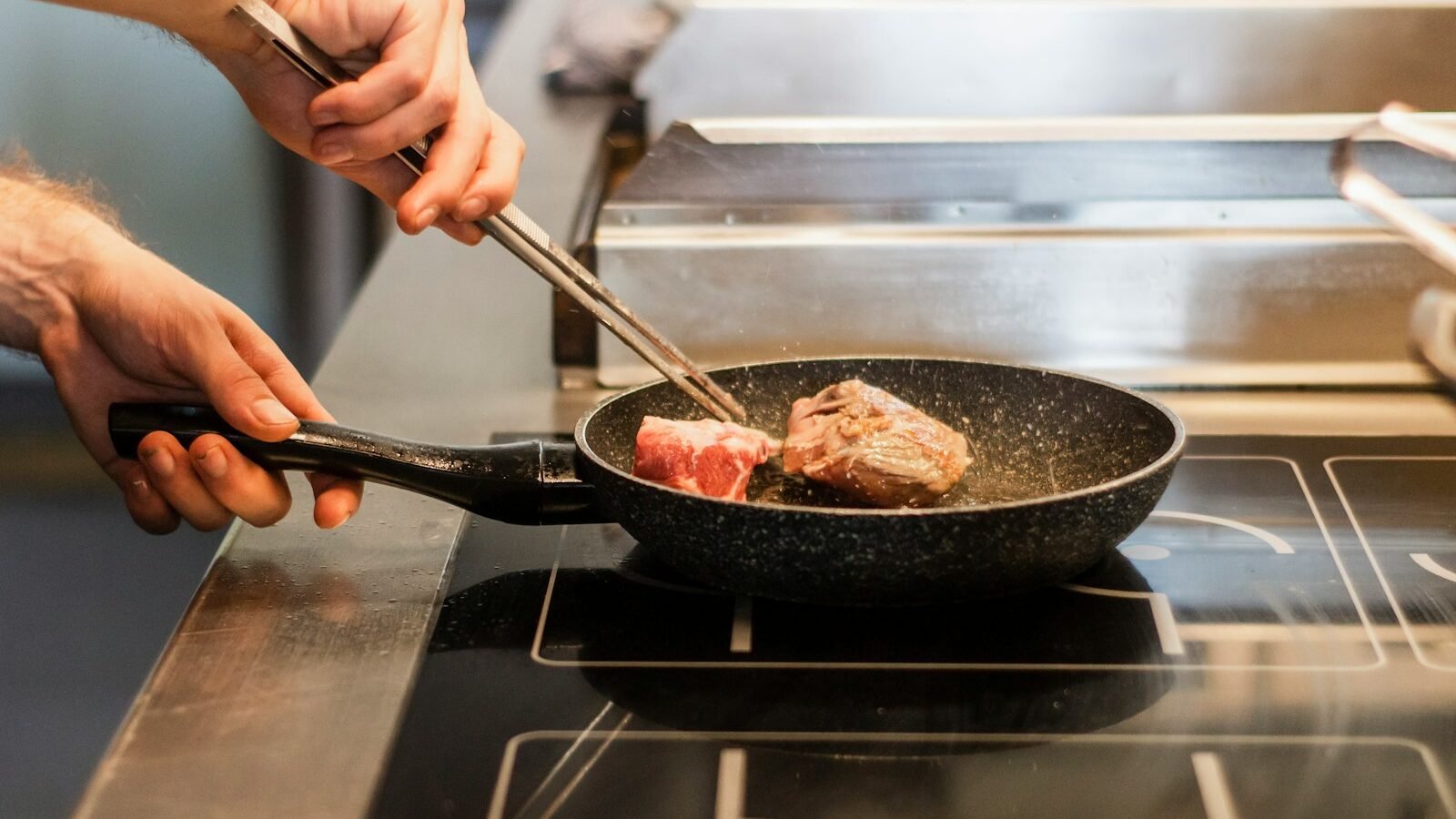
Put a steel pan on an induction hob, switch it on, and the water inside can be boiling within minutes. Yet if you lift the pan away and touch the cooking zone, it is only warm, not glowing hot like a radiant ring. Take an aluminium saucepan from the cupboard and try the same thing, and many hobs will refuse to start at all.
Those quirks are clues to how induction cooking works. Instead of making something hot and passing that heat to the pan, an induction hob uses a magnetic field to make the pan heat itself. Understanding the mechanism explains why cookware matters, why efficiency figures vary, and what the glass top is really doing.
The short answer
- A copper coil under the glass carries an alternating current, typically switching direction tens of thousands of times a second, which creates a rapidly changing magnetic field.
- That changing field induces swirling electric currents (eddy currents) in the base of a metal pan, and the pan’s own electrical resistance turns them into heat.
- Magnetic (ferromagnetic) steel and iron work best because they confine the currents to a very thin layer with high resistance; aluminium and copper heat poorly and are usually rejected.
- The glass-ceramic top is not heated directly; it warms only because the hot pan sits on it.
The basic principle: a transformer with a frying pan as the secondary
Induction relies on a basic law of electromagnetism: a changing magnetic field induces a voltage in any conductor it passes through. If that conductor forms a closed path, current flows. A transformer uses this effect to move energy from one coil of wire to another without them touching.
An induction hob works in a similar way, except that the second ‘coil’ is the metal base of the pan. The hob’s copper coil produces the changing magnetic field; the pan base, sitting on the glass above it, has currents induced in it. Because metal is not a perfect conductor, those currents meet resistance, and resistance converts electrical energy into heat (the same Joule heating that warms a kettle element). The difference is that the heat is generated inside the pan itself rather than in a hot plate underneath. The same idea, with a different goal, sits behind wireless phone charging, where the induced current is collected by a receiving coil instead of being turned into heat.
How it works, step by step
- Rectifying the mains supply. The hob converts the alternating mains supply into direct current using a rectifier.
- Generating high-frequency current. An electronic switching circuit called an inverter chops that direct current into a high-frequency alternating current. Research from the University of Zaragoza describes the usual operating range of domestic induction as roughly 20 to 100 kHz, far above the 50 or 60 Hz of household mains.
- Driving the coil. The current flows through a flat spiral coil of copper wire beneath each cooking zone. In the University of Zaragoza prototypes the coil is wound from litz wire, made of many fine strands (30 strands of 0.2 mm wire in one design), which reduces the losses that high-frequency currents cause in the winding itself.
- Creating a changing magnetic field. The alternating current in the coil produces a magnetic field that reverses direction at the same high frequency and passes up through the glass-ceramic top.
- Inducing eddy currents in the pan. The field passes into the pan base and induces circulating currents, known as eddy currents, in the metal.
- Turning current into heat. The electrical resistance of the pan base converts these currents into heat, which spreads through the pan by conduction and into the food.
- Checking for a suitable pan. The electronics monitor how the coil behaves. Many cooktops detect when no pan, or an unsuitable one, is present and will not heat, and most switch off automatically when the pan is removed.
The science behind it
Why the currents stay near the surface
High-frequency alternating currents do not spread evenly through a conductor. They crowd towards the surface facing the field, an effect called the skin effect. The thickness of this current-carrying layer is described by the skin depth, the distance over which the field and the induced current fall to about 37% (1/e) of their surface value. Standard physics teaching material gives it as:
δ = √(2ρ / (μr μ0 ω))
where ρ is the metal’s electrical resistivity, μr its relative magnetic permeability (how strongly it concentrates a magnetic field compared with empty space), μ0 the permeability of free space, and ω the angular frequency (2π multiplied by the frequency). In plain terms, the skin depth shrinks as frequency rises, as resistivity falls, and as the material becomes more magnetic.
Approximate worked example: lecture notes from the University of Texas at Austin give copper’s skin depth as about 65.2 mm divided by the square root of the frequency in hertz. At 25 kHz, the square root of 25,000 is about 158, so the skin depth is roughly 65.2 ÷ 158 ≈ 0.41 mm. At 50 Hz mains frequency the same rule gives about 9 mm. The higher the frequency, the thinner the layer in which the induced current flows.
Why magnetic steel heats so well
For a pan to heat efficiently, the induced current needs to be squeezed into a thin layer where it meets plenty of resistance. Ferromagnetic steel has a very high relative permeability and a higher resistivity than aluminium, so both factors push its skin depth down. A 2020 paper in IEEE Access by researchers at the University of Zaragoza compared a ferromagnetic stainless steel with aluminium at 100 kHz:
| Material (at 100 kHz) | Skin depth | Sheet resistance |
|---|---|---|
| Ferromagnetic stainless steel (F114) | 56 µm | about 9 mΩ per square |
| Aluminium | about 290 µm | about 0.11 mΩ per square |
Sheet resistance is a way of describing how much a thin conducting layer resists current. Steel’s value is roughly eighty times higher in this comparison, which means a given current produces far more heat in steel. Aluminium and copper, by contrast, present a low-resistance load: large currents circulate but generate comparatively little heat, and the electronics struggle to transfer power efficiently. The same paper notes that with ferromagnetic steel, the efficiency of transferring energy from coil to pan can reach up to 98%.
Iron is ferromagnetic only below its Curie temperature, which is 1043 K (about 770 °C). Normal cooking temperatures are far below this, so the magnetic behaviour of iron-based cookware is not lost during cooking.
Matching the electronics to the pan
Inside the hob, the coil and a capacitor form a resonant circuit, a combination that naturally oscillates at a particular frequency. The Zaragoza work describes the common arrangement as a series-resonant half-bridge inverter. The pan effectively becomes part of this circuit and changes its electrical behaviour. Different materials present very different loads: the paper describes aluminium and copper pans as low-impedance loads with poor induction efficiency, and notes that current cooktops automatically detect and refuse to heat such cookware.
How efficient is the whole appliance?
The coil-to-pan figure is not the same as the overall efficiency of cooking, which also includes losses in the electronics and heat escaping from the pan. A 2014 study by the Electric Power Research Institute, published in the ACEEE Summer Study proceedings, measured how much of the electrical energy ended up heating water in a pot:
| Appliance (full power) | Large pot | Small pan |
|---|---|---|
| Induction cooker A | 77.6% | 77.4% |
| Induction cooker B | 77.2% | 75.1% |
| Electric coil element | 83.4% | 41.5% |
| Natural gas burner | 35.2% | 30.2% |
The authors note that the gas tests were run at a different room temperature, so those figures are not directly comparable. The striking result is consistency: induction performed almost equally well with a small pan, while the conventional electric element lost about half its efficiency when the pan was smaller than the element. The US Department of Energy summarises induction as up to three times more efficient than gas and up to 10% more efficient than conventional smooth-top electric ranges.
Real-world applications
- Household hobs and ranges. According to a 2025 review in IEEE Industrial Electronics Magazine, domestic induction appliances have now been on the market for around fifty years.
- Portable single-zone cookers. The same electronics fit into compact plug-in units.
- Faster boiling. The US Department of Energy cites Consumer Reports testing in which induction boiled water 20–40% faster than the gas and traditional electric cooktops tested.
- Indoor air. Because nothing is burned, an induction hob produces none of the combustion gases associated with cooking on gas, a point the Department of Energy highlights.
Common misconceptions
‘The glass top gets hot like a ceramic hob’
The glass-ceramic surface is not part of the heating circuit; it is non-metallic and the field passes through it. It does warm up, but only because the hot pan sits on it. After cooking, the zone can still be hot enough to burn, so it deserves the same care as any other cooktop.
‘Induction is always the most efficient option’
It is usually the most consistent. In the EPRI measurements, a conventional electric coil heating a large pot that matched its size scored slightly higher than the induction units tested. Induction’s advantage showed up with the smaller pan and against gas.
‘Any stainless steel pan will work’
Stainless steel comes in different families. Some grades are strongly magnetic; common austenitic grades such as the 300 series are essentially non-magnetic. The simplest check, recommended by the US Department of Energy, is whether a fridge magnet sticks firmly to the flat base of the pan.
‘Aluminium and copper can never be used’
Plain aluminium and copper pans are poor induction loads and are normally rejected by the hob. However, aluminium or copper cookware can work if it is fitted with a ferromagnetic disc in the base, and researchers have even demonstrated glass pots made to work by adding thin conductive coatings.
Limitations and exceptions
- Cookware. Pans need a flat base that a magnet sticks to, so some existing cookware may need replacing.
- Glass, ceramic and plastic. Non-metallic vessels cannot be heated by induction on their own.
- Electrical supply. A built-in hob has to be connected to the household electrical supply. Installation, and any change to the household wiring, should be carried out by a qualified electrician.
- Medical devices. Because an induction hob works by producing a magnetic field just above its surface, anyone with an implanted medical device should follow the advice of their doctor and the device manufacturer.
- Overall energy use. Running costs depend on electricity prices and on how the electricity is generated, not only on appliance efficiency.
Frequently asked questions
Why will my hob not heat my aluminium pan?
Aluminium is a very good electrical conductor and is not magnetic, so the induced currents spread through a thicker layer and meet very little resistance. Little heat is produced, and most hobs detect this kind of load and decline to switch on. A pan with a ferromagnetic base disc avoids the problem.
Will an induction hob heat my hand if I touch the zone?
Your hand is not a metal conductor with suitable properties, and hobs are designed to stay off unless they detect suitable cookware. The surface can still be hot from a pan that has just been removed, so treat it with the same care as any cooktop.
Why does the pan heat so quickly?
The heat is generated inside the pan base, so there is no need to warm up an element or a hot plate first and then wait for that heat to pass across into the pan. For the same reason, heating stops as soon as the pan is lifted away.
Can I use a cast iron pan?
Yes. Cast iron is ferromagnetic and is one of the materials recommended for induction, provided the base is flat.
References
- J. Acero, I. Lope, C. Carretero and J. M. Burdío. Adapting of Non-Metallic Cookware for Induction Heating Technology via Thin-Layer Non-Magnetic Conductive Coatings. IEEE Access, vol. 8, 2020 (University of Zaragoza repository).
- M. Sweeney, J. Dols, B. Fortenbery and F. Sharp, Electric Power Research Institute. Induction Cooking Technology Design and Assessment. ACEEE Summer Study on Energy Efficiency in Buildings, 2014.
- US Department of Energy. Making the Switch to Induction Stoves or Cooktops.
- University of Texas at Austin, Department of Physics. Electromagnetic Waves in Conductors (course notes).
- OpenStax University Physics, via LibreTexts. Ferromagnets and Electromagnets.
- P. Guillén, H. Sarnago, J. Acero, J. M. Burdío, S. Llorente and Ó. Lucía. Induction Heating Appliances: Fifty Years of Technological Success: Paving the Path for Sustainable Homes. IEEE Industrial Electronics Magazine, 2025.
- EMWorks. The Science and Simulation of Induction Heating.
- Radial Magnets. Pull Force & Holding Force Explained.
Header photo: Louis Hansel on Unsplash.