How Does Wireless Charging Actually Work?
A wireless charger is a transformer split in two. A coil in the pad creates a changing magnetic field, and a coil in your phone turns it back into current. Here is the physics, and its limits.
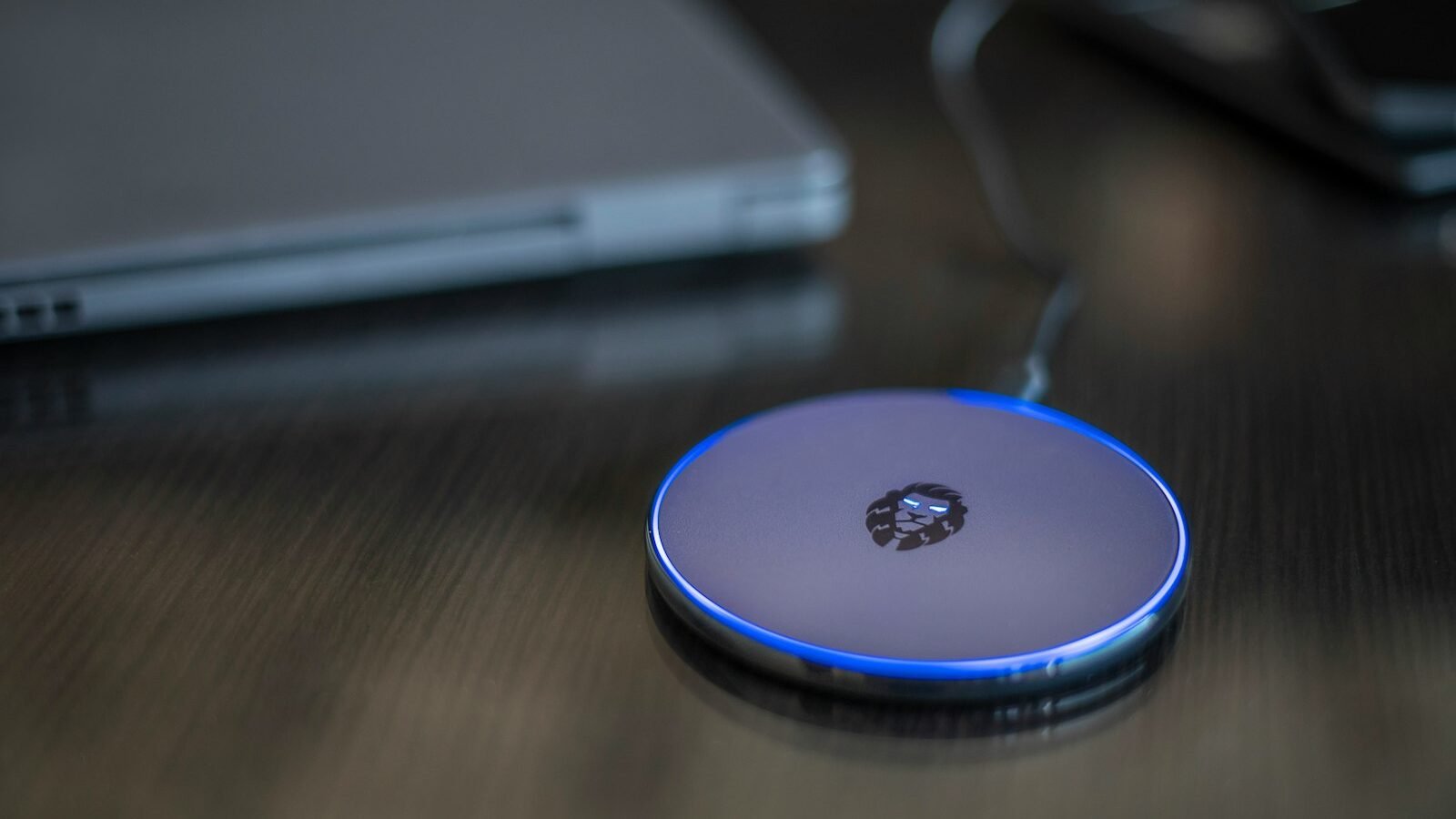
Put a phone on a charging pad and the battery icon starts to fill, with no plug and no visible connection. It can look like power is being beamed through the air. In reality, it is one of the oldest ideas in electrical engineering, Faraday’s law of induction, packed into two flat coils a few millimetres apart.
The short answer
- The charging pad drives an alternating current through a flat copper coil, creating a magnetic field that changes direction many thousands of times per second.
- A matching coil inside the phone sits in that field. The changing field induces an alternating current in it, which the phone converts to direct current to charge the battery.
- The dominant standard, Qi from the Wireless Power Consortium, operates at roughly 87 to 205 kHz, with phones commonly charging at up to 15 W.
- Charger and phone talk to each other throughout, adjusting power and shutting off if something unexpected, such as a coin, is detected on the pad.
The basic principle: a transformer split in two
A conventional transformer has two coils of wire wound around a shared iron core. Alternating current in one coil produces a changing magnetic field in the core, which induces a voltage in the second coil. No electrical connection runs between them; energy crosses via the magnetic field.
An inductive wireless charger is the same arrangement with the core removed and the two halves separated. One coil, the transmitter, is in the pad. The other, the receiver, is in the phone. Bring them close together and they behave like a loosely coupled transformer.
How it works, step by step
- Standby and detection. The pad periodically checks for something placed on it. When it detects a possible receiver, it sends a short burst of power.
- Handshake. A compatible phone wakes up and identifies itself, reporting what it needs. If no valid response comes back, the pad does not start charging.
- Power transfer. The transmitter drives alternating current through its coil. The resulting magnetic field passes through the receiver coil and induces an alternating current in it.
- Conversion. Electronics in the phone rectify that current into direct current and regulate it for the battery charging circuit.
- Continuous control. Throughout charging, the phone sends feedback asking for more or less power. The pad responds, for example by adjusting its operating frequency.
- Safety checks. The pad watches for signs of foreign metal objects and stops when charging is finished or something looks wrong.
The science behind it
Faraday’s law of induction
Faraday’s law states that a changing magnetic field through a loop of wire induces a voltage in that loop. The faster the field changes, and the more of it passes through the loop, the larger the voltage. A steady magnetic field induces nothing, which is why wireless chargers use alternating current: the field must keep changing to keep energy flowing.
Coupling and distance
Not all of the field from the transmitter coil passes through the receiver coil. The fraction that does is described by the coupling coefficient. Coupling falls off quickly as the coils move apart or out of line, and lower coupling means lower efficiency and more heat. Qi coils are typically around 5 mm apart in use, and the standard covers transfer over distances up to about 40 mm. That is why the phone must sit on the pad, not near it.
Resonance and frequency control
Each coil is paired with capacitors to form a tuned circuit with a resonant frequency. Operating near resonance lets useful power transfer happen with less drive. Technical literature on the Qi standard describes transmitters regulating output by moving their operating frequency along the resonance curve; within the range used, a higher frequency gives lower power.
Talking through the same field
The receiver communicates with the transmitter without a separate radio. It sends data by changing the load it presents on the coil in a coded pattern, which the transmitter can sense as small changes in its own coil current and voltage. This in-band channel carries the identification, power requests and end-of-charge messages.
Shielding and foreign objects
Behind each coil sits a layer of magnetic shielding material that guides the field towards the other coil and away from nearby electronics and batteries. Stray metal on the pad, such as keys or coins, can absorb energy from the field as circulating eddy currents and heat up. Qi chargers include foreign object detection, which estimates whether more power is leaving the pad than the receiver reports receiving, and cuts power if so.
Real-world applications
- Phones and earbuds. The most familiar use. Qi’s Extended Power Profile supports up to 15 W.
- Cars. Many vehicles include a Qi pad in the centre console.
- Magnetic alignment. Qi2 adds a magnetic attachment profile based on Apple’s MagSafe, so the phone snaps into the best position over the coil.
- Higher-power uses. The same physics scales up. The Wireless Power Consortium’s Ki standard targets cordless kitchen appliances, and research systems have demonstrated wireless charging for electric vehicles at tens of kilowatts.
Common misconceptions
“Wireless charging sends power by radio”
Qi does not radiate power across a room like a radio transmitter. It uses near-field magnetic coupling, which only works efficiently when the coils are very close together.
“Any position on the pad is fine”
Alignment matters. If the phone’s coil is off-centre, coupling drops, charging slows and more energy is lost as heat. Some pads use multiple coils to cover a larger area; magnetic alignment in Qi2 addresses the same problem.
“Wireless charging is just as efficient as a cable”
Some energy is always lost in the coils, the shielding and the conversion electronics. In practice, inductive charging is less efficient than a direct cable connection, and that lost energy appears as heat.
Limitations and exceptions
- Heat. Lost energy warms the phone and pad. Phones reduce charging power when they get warm, so wireless charging is often slower in practice than its headline rating.
- Cases and gaps. Thick cases increase the distance between coils and reduce coupling. Cases containing metal plates or cards with metal can interfere, and may trigger foreign object detection.
- Bank cards. Cards with magnetic stripes or contactless chips should not be left between the phone and the pad.
- Not every “fast wireless” mode is standard. Some manufacturers use proprietary higher-power modes that only work with their own chargers.
Frequently asked questions
Does wireless charging damage my battery?
The main concern is heat, which accelerates battery ageing. A well-designed charger and phone manage temperature by reducing power. Charging in a hot car or under a pillow makes heat more of an issue.
Why does my phone stop charging when I move it slightly?
Moving the coils out of alignment reduces coupling. If it drops far enough, the charger cannot maintain the power the phone needs, or the handshake fails.
Can a wireless charger work through a table?
Some under-desk chargers are designed to work through thin surfaces, but only within the short distances the coils are designed for. Through a thick table top, coupling is usually too weak.
Is it safe to put metal objects on the pad?
Metal objects can heat up in the field. Qi chargers are designed to detect them and stop, but it is best not to leave keys, coins or foil on a charging pad.
References
- iTeh Standards. EN IEC 63563-1:2025, Qi Specification version 2.0, Part 1: Introduction, standard summary.
- Wireless Charger Networking for Mobile Devices: Fundamentals, Standards, and Applications. arXiv:1410.8635.
- Electronic Design. Power Management Chapter 12: Wireless Power Transfer.
- Wikipedia contributors. Qi (standard).
- Design World. Basics of wireless power transmission design, Internet of Things Handbook (2019).
Header photo: Georgi Dyulgerov on Unsplash.