Why Does Water Form Round Droplets?
Small amounts of water pull themselves into spheres because a sphere has the least surface for its volume. Here is how surface tension does it, and when gravity wins.
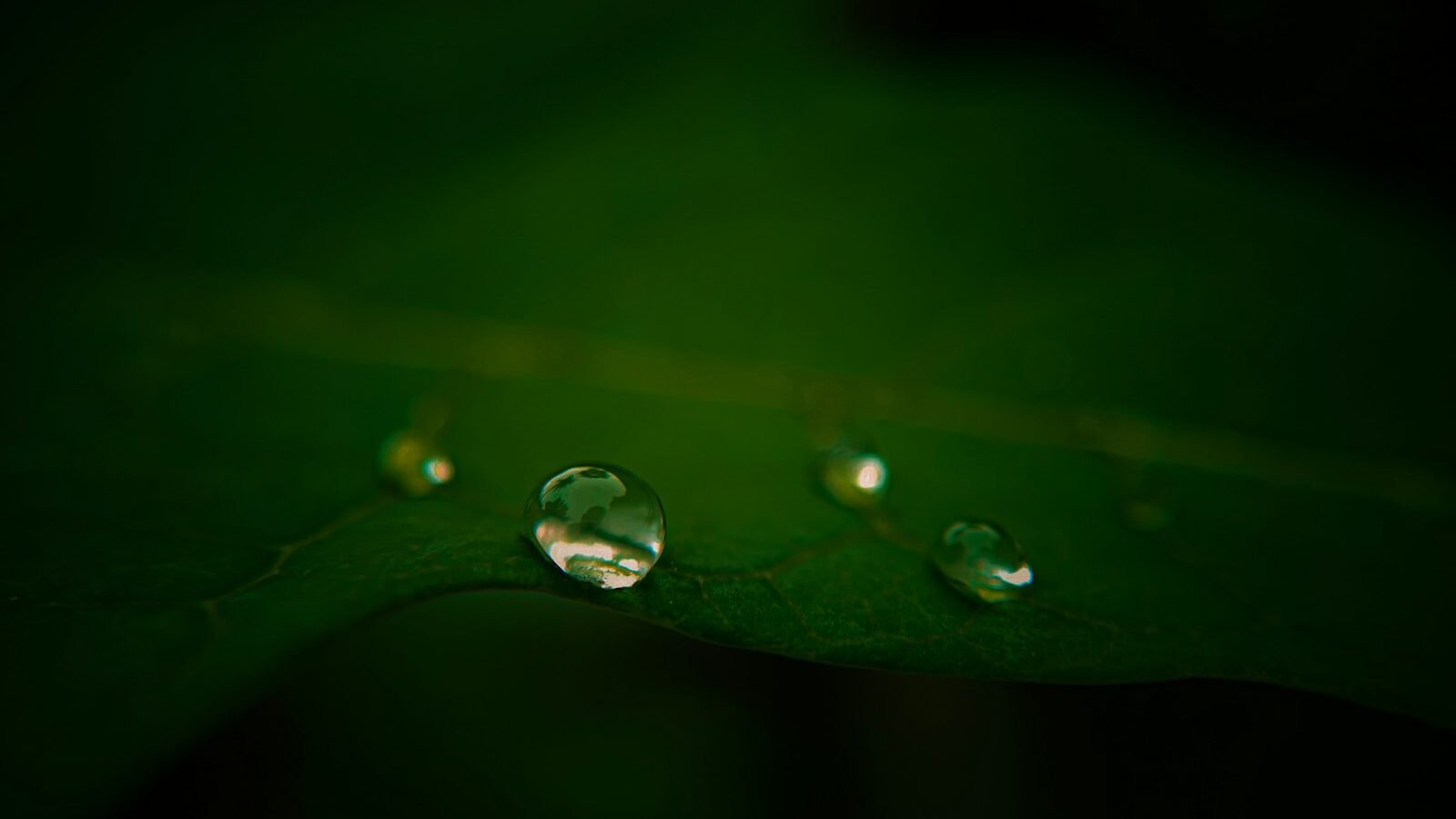
Look closely at dew on a leaf, mist on a car bonnet or a splash on a freshly waxed table and you will see the same thing: water gathering itself into small, rounded beads. Liquids are supposed to take the shape of their container, so why does a drop that has no container at all end up looking like a tiny marble?
The answer explains far more than raindrops. The same effect decides whether paint spreads or crawls, why detergents clean, how inkjet printers place their dots and why some fabrics shrug off rain. It comes down to a property of every liquid surface called surface tension, and to a contest between that tension and gravity.
The short answer
- Molecules at the surface of water are pulled inwards by their neighbours, so the liquid behaves as if it were wrapped in a stretched elastic skin.
- A stretched skin tries to make its area as small as possible, and for a fixed volume the shape with the least surface area is a sphere.
- Small drops stay almost perfectly round; larger drops sag or flatten because gravity and air resistance start to compete with surface tension.
- What the drop is sitting on matters too: water-repellent surfaces let it bead up, while water-attracting surfaces make it spread.
The basic principle: surfaces cost energy
Inside a body of water, each molecule is surrounded on all sides by other water molecules that attract it. Those attractions largely cancel out. A molecule at the surface is in a different position: it has neighbours below and beside it but only air above. The pull it feels is therefore lopsided, with a net tug back into the liquid. In water the attraction comes mainly from hydrogen bonds, the relatively strong links that form between the hydrogen atoms of one molecule and the oxygen of another. Surface molecules have lost some of those bonds, so they sit at a higher energy than molecules in the interior.
Because every molecule moved to the surface costs some energy, a liquid that is free to change shape will rearrange itself to expose as little surface as it can. Physicists express this as surface tension, which can be read in two equivalent ways: as the energy needed to create one extra square metre of surface, or as a force pulling along each metre of the surface edge. The everyday description of a liquid behaving like a stretched membrane is a good mental picture, as long as you remember that no separate skin actually exists; it is simply the outermost layer of the same liquid.
Geometry finishes the argument. Of all possible shapes that hold a given volume, the sphere has the smallest surface area. A drop that is left to itself, with nothing else pushing or pulling on it, will therefore settle into a sphere.
How it works, step by step
- A small volume of water separates from a larger body, for example as it drips from a tap, condenses from vapour or is thrown off as spray.
- Its surface is at first irregular. Any bulge or corner adds extra surface area, and therefore extra energy.
- Surface tension pulls the surface inwards. Where the surface is sharply curved, the inward pull is strongest, so bulges are drawn back and hollows are filled out.
- The drop oscillates briefly as it overshoots and recovers, and the internal friction of the liquid (its viscosity) damps out those wobbles.
- It settles at the lowest-energy shape, which for a small, freely floating drop is a sphere. If the drop is resting on a surface or falling quickly through air, other forces take part and the final shape is a compromise.
The science behind it
How strong is water’s surface tension?
Surface tension is measured in newtons per metre (N/m), or more conveniently millinewtons per metre (mN/m). For pure water at 20 °C the tabulated value is about 72.75 mN/m, falling to about 59 mN/m at 100 °C. That is high for a common liquid, which is why water forms such distinct beads. Warming water lowers its surface tension, and so do soaps and detergents, which collect at the surface and weaken the inward pull. That is precisely why soapy or hot water wets fabric and soaks into small gaps more readily than cold, clean water.
Why the sphere wins
The advantage of the sphere is easy to check with a little geometry. The table below compares the surface area needed to enclose the same 10 cm³ of water in four different shapes. The figures are approximate and calculated from standard formulas, with the cylinder taken at its most economical proportions (height equal to diameter).
| Shape holding 10 cm³ | Approximate surface area | Extra area compared with a sphere |
|---|---|---|
| Sphere | 22.4 cm² | — |
| Cylinder (height = diameter) | 25.7 cm² | about 15% |
| Cube | 27.8 cm² | about 24% |
| Regular tetrahedron | 33.4 cm² | about 49% |
Every extra square centimetre is extra surface energy, so any shape other than a sphere is, in effect, a higher-energy state that surface tension will try to undo.
The pressure inside a drop
A curved surface under tension squeezes whatever is inside it. For a spherical drop of radius r, the pressure inside exceeds the pressure outside by the Laplace pressure:
ΔP = 2γ / r
where γ (gamma) is the surface tension. Smaller drops are more sharply curved and so are squeezed harder. As an approximate worked example, using γ ≈ 0.0728 N/m:
- A drop 1 mm across (r = 0.5 mm): ΔP ≈ 2 × 0.0728 ÷ 0.0005 ≈ 290 Pa.
- A mist droplet 0.1 mm across (r = 0.05 mm): ΔP ≈ 2,900 Pa, ten times higher.
This pressure is what resists any attempt to distort the drop. Where part of a drop bulges out, its curvature, and therefore its internal pressure, changes, pushing liquid back until the curvature is the same everywhere. A sphere is the only closed shape with identical curvature at every point.
When gravity takes over: the capillary length
Surface tension is not the only force on a drop. Gravity pulls the liquid downwards and tries to flatten it. Which effect dominates depends on size, and physicists capture the crossover in a quantity called the capillary length:
ℓc = √(γ / ρg)
where ρ is the liquid’s density and g is the acceleration due to gravity. For water at room temperature this works out at about 2.7 mm. Drops much smaller than this are ruled by surface tension and are close to spherical. Drops much larger than it are ruled by gravity, which is why a large spill on a table spreads into a flat puddle rather than a dome. The ratio of the two effects is often written as the Bond number, roughly Bo = ρgR² / γ; values well below 1 mean a rounder drop.
Drops on surfaces: the contact angle
A drop resting on a solid has three interfaces to balance: liquid and air, liquid and solid, and solid and air. The result is described by the contact angle, the angle the drop’s edge makes with the surface. Young’s equation links that angle to the three interfacial tensions. In practice, surfaces are commonly grouped like this:
| Surface type | Typical contact angle | What water does | Examples |
|---|---|---|---|
| Hydrophilic (water-attracting) | Below 90° | Spreads into a thin film or low dome | Clean glass, rusted metal |
| Hydrophobic (water-repelling) | Above 90° | Forms raised beads | PTFE (Teflon), oily or waxed surfaces |
| Superhydrophobic | Above 150° | Forms near-spherical beads that roll off easily | Lotus leaves, specially textured coatings |
Superhydrophobic surfaces combine water-repelling chemistry with very fine roughness at the micrometre and nanometre scale. The drop rests on the tips of the tiny bumps with pockets of air trapped beneath it, so it touches very little solid and stays almost perfectly round.
Real-world applications
Rain and weather radar. Falling raindrops are not teardrop-shaped. The smallest are close to spherical; larger ones are flattened underneath by the air rushing past, giving a shape often compared to a hamburger bun. According to one summary of laboratory measurements, drops above about 3 mm across flatten noticeably, their fall speed levels off at around 29 km/h, and at roughly 5.5 mm the air forces overcome surface tension and the drop breaks up. Weather radars use the flatness of drops to help judge how heavy rainfall is.
| Drop size (diameter) | Approximate behaviour |
|---|---|
| Cloud or fog droplets (around 0.02 mm) | Spherical; fall at roughly 1 cm/s |
| About 1 mm | Close to spherical; fall at about 16 km/h |
| About 3 mm | Flattening begins; fall at about 28 km/h |
| 4–5 mm | Clearly flattened; fall speed levels off near 29 km/h |
| About 5.5 mm | Breaks up into smaller drops |
Cleaning and wetting. Detergents work partly by lowering surface tension so that water spreads over surfaces and seeps into fibres instead of sitting on top as beads.
Water-repellent coatings. Car waxes, outdoor clothing treatments and self-cleaning coatings raise the contact angle so that water beads and rolls away, often carrying dirt with it.
Industry. Spray painting, crop spraying and inkjet printing all depend on controlling droplet size and how droplets wet a surface. Even protective paint on steel relies on good wetting when it is applied; once it is damaged, water can creep beneath it, as explained in our article on why rust spreads beneath paint.
Common misconceptions
Raindrops are teardrop-shaped
The classic teardrop with a pointed top is a drawing convention, not what falling rain looks like. Small raindrops are near-spheres and larger ones are flattened underneath, more like a bun than a tear.
Water has a real skin on top
The surface behaves like a stretched membrane, and a steel paper clip or a pond skater can rest on it, but there is no separate film. The effect comes from the same molecules as the rest of the liquid, arranged at the boundary where their attractions are unbalanced.
Only water forms droplets
All liquids have surface tension and all form droplets. Water simply has a relatively high surface tension, so its beads tend to be more pronounced than those of liquids with lower values.
Limitations and exceptions
The neat sphere is an idealisation. On Earth, any drop bigger than a few millimetres is visibly distorted by gravity, and a drop resting on a surface is shaped by the contact angle as much as by surface tension. Real surfaces are rarely perfectly smooth or clean, so the same drop can show a different angle on its advancing and receding edges, which is why drops sometimes stick on a sloping window instead of sliding.
Impurities change the picture too. Small amounts of soap, oil or other surface-active substances can lower surface tension sharply, making drops flatter and less stable. Temperature matters as well, since warmer water has a lower surface tension. Finally, drops moving through air, such as raindrops or spray, oscillate and deform continuously; the shapes described here are averages.
Frequently asked questions
Why do drops on a waxed car look rounder than on glass?
Wax is hydrophobic, so water has a high contact angle on it and pulls itself into tall beads. Clean glass is hydrophilic, so the same water spreads out into a flatter film.
Does adding soap change the shape of drops?
Yes. Soap lowers surface tension, so the forces holding the drop together weaken and it spreads more easily across a surface. This is the reason soapy water is better at wetting and cleaning.
Why do bubbles also end up round?
A soap bubble is a thin film of liquid with two surfaces, and the same tendency to minimise surface area pulls it into a sphere around the trapped air.
Is there a maximum size for a raindrop?
In practice, yes. As drops grow they flatten and fall faster, and at roughly 5.5 mm in diameter the air pressure on the underside overcomes surface tension and the drop breaks into smaller ones.
References
- U.S. Geological Survey, Water Science School. Surface Tension and Water.
- Hunt Research Group, Imperial College London. Surface Tension of Water.
- Lidon, P. Capillarité (lecture notes on surface tension), arXiv:1510.05508.
- Hermans, L.J.F. Water from Heaven. Europhysics News, 37(5), 2006.
- U.S. Geological Survey. Raindrop shape is determined by drop size and air resistance.
- NASA Scientific Visualization Studio. Anatomy of a Raindrop.
- Lawrence Hall of Science, University of California, Berkeley. Superhydrophobic Surfaces.
Header photo: Sujay Paul on Unsplash.