How Is Tempered Glass Manufactured?
Tempered glass starts as ordinary glass. Heating it to about 620 °C and blasting it with air locks the surface in compression, making it around four times stronger and safer when it breaks.
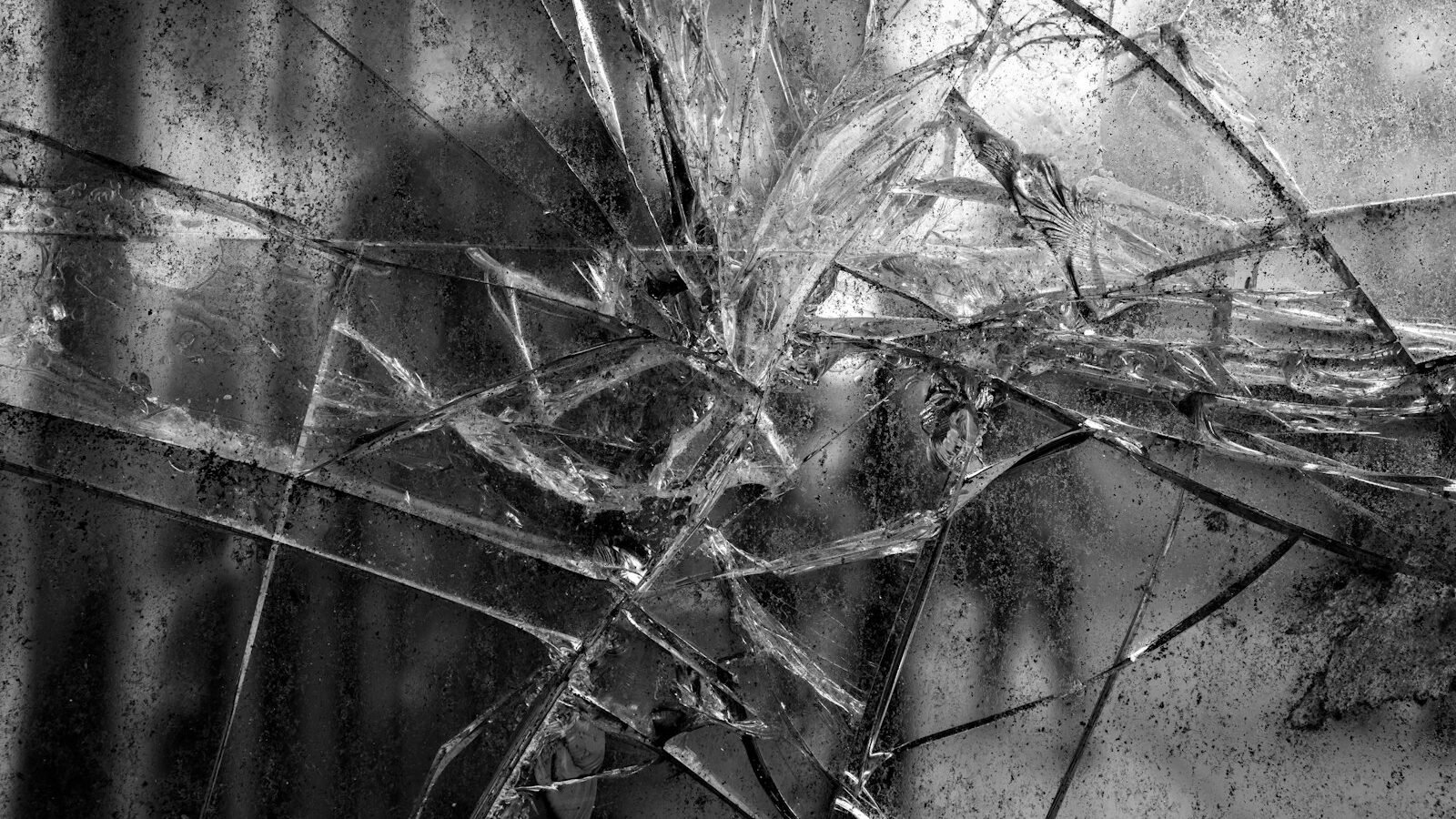
The glass in a shower screen, an oven door, a car’s side window or a glass table top looks exactly like window glass. Yet it can take a much harder knock, and when it does break, it crumbles into small, blunt pieces rather than long, sharp shards. That difference is created in a few seconds at the end of a carefully controlled heating and cooling process.
The short answer
- Tempered (toughened) glass starts as ordinary annealed float glass, cut and finished to its final size first.
- It is heated in a furnace to about 620 °C, then its surfaces are rapidly cooled with high-pressure air jets. This step is called quenching.
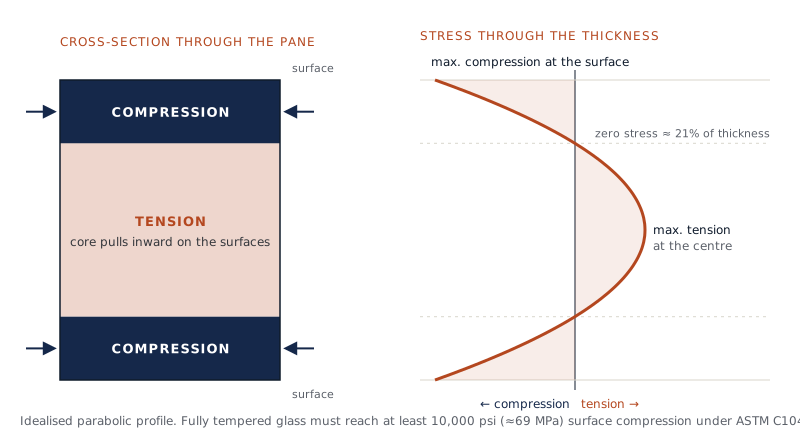
- The surfaces harden first; when the core cools and contracts later, it pulls the surfaces into permanent compression and leaves the core in tension.
- Fully tempered glass is roughly four times stronger than annealed glass and breaks into small fragments, which is why it counts as safety glass.
The basic principle: glass breaks in tension
Glass is very strong when squeezed but comparatively weak when pulled. Its surface always carries microscopic flaws: scratches, tiny chips at the edges and defects from handling. When glass bends, one face is stretched. Stress concentrates at the tip of a surface flaw, the flaw grows into a crack, and the glass breaks.
Tempering does not remove those flaws. Instead, it puts the whole surface into a state of built-in compression. Before a flaw can open into a crack, any applied load first has to overcome that compression. The result is a much higher load before failure.
How it is made, step by step
- Cutting to size. The process starts with annealed float glass, the ordinary glass made by floating molten glass on a bath of molten tin. It is cut to its final dimensions before tempering.
- Edge work and holes. Edges are ground or polished and any holes or notches are made at this stage. After tempering, cutting, drilling or edging is not possible.
- Washing and inspection. The glass is cleaned and checked for flaws such as bubbles, stones and scratches, which can cause breakage during processing or weaken the finished product.
- Heating. The glass travels through a tempering furnace, either in batches or continuously on rollers. It must get hot enough for the glass to be able to relax internal stresses, but not so hot that it sags or distorts. A technical guide from glass manufacturer AGC specifies a glass exit temperature of 620 °C ± 10 °C.
- Quenching. As the glass leaves the furnace, arrays of nozzles blow high-pressure air onto both faces at once. This cools the surfaces far faster than the centre. The quench itself lasts only a few seconds.
- Controlled cooling. The glass continues to cool to room temperature, with further air cooling to stop the surfaces reheating from the hot core.
- Quality checks. Producers measure surface compression without breaking the glass, using optical instruments that read stress patterns. Sample panes are also deliberately broken to check that they fragment correctly.
- Optional heat soak test. For some applications, especially building façades, finished panes are reheated for a heat soak test to weed out glass with harmful inclusions (explained below).
The science behind it
Where the stress comes from
When the air jets hit the hot glass, the outer layers cool and stiffen almost immediately. The core is still hot and soft enough to adjust. As the core then cools, it tries to shrink. But it is now bonded to rigid outer layers that have already set at a larger size. The shrinking core pulls inward on the surfaces, squeezing them into compression, while the core itself is left in tension.
These stresses balance each other across the thickness of the pane. They are locked in permanently; the glass is chemically identical to what went into the furnace. Only its internal stress state has changed.
How strong is strong?
Standards set minimum surface compression levels. ASTM C1048, the US specification for heat-treated flat glass, requires fully tempered glass to have a surface compression of at least 10,000 psi (about 69 MPa). Annealed glass typically breaks at around 6,000 psi, while tempered glass generally breaks at around 24,000 psi, roughly four times as strong in bending.
A lower quench pressure produces heat-strengthened glass instead, with surface compression between 3,500 and 7,500 psi. It is about twice as strong as annealed glass but breaks into larger pieces and is not classed as safety glass on its own.
Why it shatters into small pieces
A tempered pane stores a large amount of elastic energy in its balanced stress state. If a crack penetrates the compressive surface layer and reaches the tensile core, that energy is released all at once. Cracks branch rapidly through the whole pane, dividing it into small, roughly cube-shaped fragments with relatively blunt edges. This is called dicing. Standards test it directly by breaking samples and counting the fragments in a 50 mm × 50 mm area.
Real-world applications
- Buildings. Doors, shower screens, low windows, balustrades and other locations where people could fall against glass usually require safety glazing.
- Appliances. Oven doors and cooktop parts benefit from tempered glass’s improved resistance to thermal stress.
- Vehicles. Side and rear windows in many cars are tempered. Windscreens are normally laminated instead, so they stay in one piece when cracked.
- Furniture. Table tops and shelving use tempered glass for its strength and safer breakage.
Common misconceptions
“Tempered glass is unbreakable”
It is stronger, not unbreakable. It is particularly vulnerable at its edges and to sharp point impacts. A small chip on an edge can be enough to break a whole pane.
“You can cut tempered glass to fit”
Cutting, drilling or grinding breaches the compressive surface and releases the stored stress. The pane will usually shatter completely. All fabrication has to be finished before tempering.
“Tempered glass is a different material”
It is the same soda-lime glass as annealed glass. The improvement comes from the stress pattern created by heating and quenching.
Limitations and exceptions
Spontaneous breakage
Very occasionally, a tempered pane breaks with no obvious cause, sometimes years after installation. A common culprit is a tiny nickel sulphide (NiS) inclusion left from the glass-making process. The quench traps the inclusion in a high-temperature crystal form that is unstable at room temperature. Over time it slowly transforms and expands. If it sits in the tensile core, the extra stress can be enough to break the pane.
The heat soak test, described in the European standard EN 14179-1, holds tempered glass at 290 °C ± 10 °C for two hours to force susceptible panes to break in the factory rather than on a building. It greatly reduces the risk but cannot eliminate it entirely.
Optical distortion
Because glass softens slightly while travelling over furnace rollers, tempered glass can show subtle roller-wave distortion and, under polarised light, faint stress patterns sometimes called quench marks. These are normal features of the process.
Chemical tempering is different
Thin glass, such as some phone cover glass, is often strengthened chemically instead. The glass is immersed in a molten salt bath where smaller sodium ions near the surface are exchanged for larger potassium ions, which crowd the surface into compression. This avoids heat distortion but costs more.
Frequently asked questions
How can I tell if glass is tempered?
Tempered safety glass used in buildings is often marked with a small permanent stamp in a corner. Viewing it through polarised sunglasses may also show faint patterns from the quench, though this is not a definitive test.
Is toughened glass the same as tempered glass?
Yes. “Toughened” is the common term in the UK, Australia and Europe; “tempered” is common in North America.
Why are car windscreens not tempered?
Windscreens are usually laminated: two layers of glass bonded to a plastic interlayer. When struck, they crack but stay in place, which helps keep occupants inside the vehicle and maintains visibility.
Can tempered glass break from heat?
It handles temperature differences much better than annealed glass, but large or very sudden temperature differences, or damage at the edges, can still cause failure.
References
- Scientific American. How is tempered glass made?
- AGC Glass. Heat Treated Glass Overview, technical document (PDF).
- Viracon. Heat-treated glass, technical information referencing ASTM C1048.
- National Glass Association. FB56-18 Heat Soak Testing of Tempered Glass for Architectural Glass Applications (PDF).
- Article on nickel sulphide inclusions and the EN 14179-1 heat soak test. Glass Structures & Engineering (2025), Springer.
- Glas Trösch. Spontaneous breakage of thermally toughened safety glass, technical leaflet (PDF).
- Infinita Lab. Tempered glass: properties, testing methods and standards (fragmentation testing to ASTM C1048 and EN 12150).
Header photo: Salah Ait Mokhtar on Unsplash.