Why Do Metal Objects Feel Colder Than Wooden Objects?
A metal rail and a wooden bench in the same room are at the same temperature, yet the metal feels much colder. The reason is a property called thermal effusivity.

On a cool morning, grab a metal railing and then sit on a wooden bench beside it. The railing feels icy and the bench feels almost neutral. Measure both with a thermometer and they will read the same temperature, because they have been sitting in the same air all night.
Your hand is not lying to you, but it is not measuring what you think. Skin does not report the temperature of the object. It reports what happens to your skin when it touches the object, and that depends on how fast heat flows out of you.
The short answer
- Objects at the same temperature can feel very different because skin senses heat flow and its own surface temperature, not the object’s temperature.
- Metal pulls heat out of your skin much faster than wood, so the skin surface cools quickly and you feel cold.
- The property that decides this is thermal effusivity, which combines thermal conductivity, density and heat capacity.
- The effect reverses for hot objects: at the same high temperature, metal feels hotter than wood.
The basic principle: you feel heat flow, not temperature
Your skin surface is normally around 30 to 35 °C, warmer than a typical room. When you touch something cooler, heat flows from your skin into it. Nerve endings called thermoreceptors respond to the resulting change in skin temperature and to the rate of heat flow. A fast drop feels cold; a slow, small drop feels neutral.
So the question is not “which object is colder?” but “which object makes my skin colder, faster?”
How it works, moment by moment
- Contact. Your fingertip, at roughly 33 °C, touches a surface at room temperature, say 20 °C.
- An interface temperature forms almost instantly. At the boundary between skin and object, the temperature settles somewhere between the two starting temperatures.
- Where it settles depends on the materials. If the object can absorb and carry away heat very effectively, the interface temperature ends up close to the object’s temperature. If it cannot, the interface stays close to skin temperature.
- Your thermoreceptors respond. An interface near 20 °C feels cold. An interface near 29 °C feels only slightly cool.
- Over time, things change. If you keep holding the object, the material near your hand warms up and the sensation fades. The effect is strongest in the first seconds of contact.
The science behind it
Conductivity is only part of the story
The usual explanation is that metal is a better thermal conductor than wood. That is true and important. Metals carry heat efficiently because their free electrons transport energy through the material, while wood is full of tiny air-filled cells that resist heat flow. Copper conducts heat thousands of times better than wood.
But conductivity alone does not fully explain what you feel. A material also needs to be able to absorb heat without warming up much at the surface. That depends on its volumetric heat capacity: how much energy each cubic centimetre must take in to rise by one degree.
Thermal effusivity
Heat transfer engineers combine these properties into one quantity, thermal effusivity:
e = √(k × ρ × c)
where k is thermal conductivity, ρ is density and c is specific heat capacity. Effusivity measures how readily a material exchanges heat with something it touches. For two bodies brought into good contact, the interface temperature is a weighted average of their starting temperatures, weighted by effusivity:
Tcontact = (eskin × Tskin + eobject × Tobject) ÷ (eskin + eobject)
The material with the higher effusivity “wins”, pulling the interface temperature towards its own.
Putting numbers on it
Published effusivity values at room temperature, in kJ per square metre per kelvin per square-root second, include:
| Material | Approximate effusivity |
|---|---|
| Cork | 0.1 |
| Pine wood | 0.36–0.66 |
| Stainless steel 316 | 7.2 |
| Iron | 15.9 |
| Aluminium | 23.7 |
| Copper | 36.9 |
Human skin is often modelled with an effusivity of roughly 1.2 in the same units, although real values vary between people and body areas. Using that estimate, skin at 33 °C and objects at 20 °C, the formula gives approximate interface temperatures of:
- Pine (taking 0.5): about 29 °C. Only slightly cooler than skin, so it feels neutral.
- Stainless steel: about 22 °C.
- Aluminium: about 20.6 °C, almost the full temperature of the object.
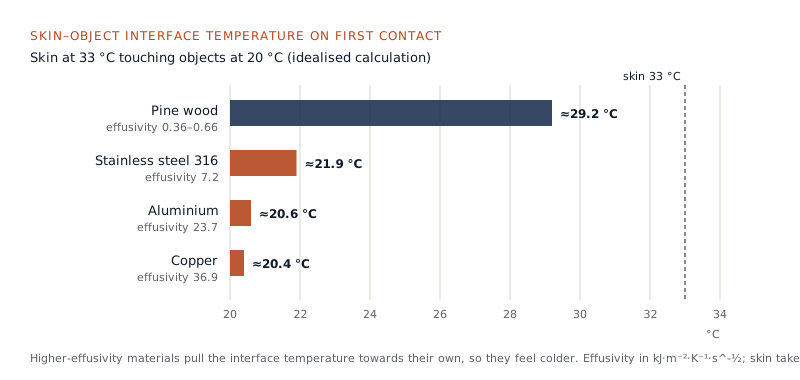
These are idealised figures. They assume perfect, smooth contact and thick objects, and ignore moisture and surface roughness. But they capture the effect: touching metal drops your skin surface by more than 10 °C almost instantly, while touching wood drops it by around 4 °C.
Real-world applications
- Saunas. Benches are made of wood partly because at high temperatures wood’s low effusivity keeps the contact temperature tolerable. A metal screw head at the same temperature can burn.
- Cookware handles. Wooden and plastic handles stay comfortable because they exchange heat slowly with your hand.
- Flooring. Stone and tile feel cold underfoot compared with timber or carpet at the same room temperature. Carpet and cork have very low effusivity because of the air they trap.
- Material identification by robots. Researchers have built tactile sensors that identify materials by how quickly a heated fingertip-like sensor cools on contact, using exactly this principle.
Common misconceptions
“The metal is actually colder”
Not if both objects have been in the same place for a while. They reach the same temperature as their surroundings. The difference is in heat flow when you touch them.
“Metal is cold, wood is warm”
Metal is not inherently cold. Above skin temperature the effect reverses. Experiments with metal and wood at around 40 °C show the metal feeling warmer, because it delivers heat into your skin faster.
“It is only about conductivity”
Conductivity matters most, but heat capacity matters too. Water, for example, has fairly low conductivity, yet room-temperature water feels cold, partly because of its high heat capacity and partly because moving water carries heat away by convection.
Limitations and exceptions
- Thin objects behave differently. The formula assumes the object is thick enough that heat does not reach the far side quickly. A thin sheet of metal warms up fast and the cold sensation fades sooner.
- Contact quality matters. Rough or textured surfaces touch your skin at fewer points, which reduces heat flow. A brushed or patterned metal surface can feel less cold than a polished one.
- Coatings change the feel. Paint, powder coating or a thin layer of plastic adds a low-effusivity barrier, which is why coated metal furniture feels warmer than bare metal.
- Skin varies. Cold hands, sweaty hands and calloused skin all change how strongly you perceive the difference.
Frequently asked questions
Is it the same reason tiles feel colder than carpet?
Yes. Ceramic tile and stone have much higher effusivity than carpet, which traps a lot of air. At the same floor temperature, tiles draw heat from your feet far faster.
Why does a metal spoon in hot tea burn but a wooden one does not?
Two effects add up. Metal conducts heat from the tea up the handle much faster than wood, so the handle gets hotter. And at any given temperature, metal transfers that heat into your fingers more quickly.
Does this work in space or in a vacuum?
Effusivity describes conduction through direct contact, so the same principle applies wherever two solids touch. What changes in a vacuum is that there is no air to cool objects by convection.
Which metal feels coldest?
Among common metals, copper and aluminium have higher effusivity than iron or stainless steel, so they tend to feel colder at the same temperature. The differences are smaller than the gap between any metal and wood.
References
- Wikipedia contributors. Thermal effusivity (definition, contact temperature relationship and table of values with primary references).
- Thermtest. Touch Metal, Touch Wood Experiment.
- tec-science. Why does metal feel colder than wood at the same temperature?
- Material Classification Using Active Temperature Controllable Robotic Gripper. arXiv:2111.15344.
- Analyzing Material Recognition Performance of Thermal Tactile Sensing using a Large Materials Database and a Real Robot. arXiv:1711.01490.
Header photo: Lasse Møller on Unsplash.